Regulation issued by Guangdong MSA regarding the supervision and management of marine traffic safety in the Special Administrative Area of Pearl River Estuary of China
Guangdong MSA issued a Regulation on the Administration of Special Administrative Area of Pearl River Estuary for Marine Traffic Safety (for Trial Implementation) recently, which will come into effect as of 01 July 2024 with validity of two years. A summary of ships’ safe navigation requirements is given below for your easy reference with our free English translation of the regulation attached to this circular.
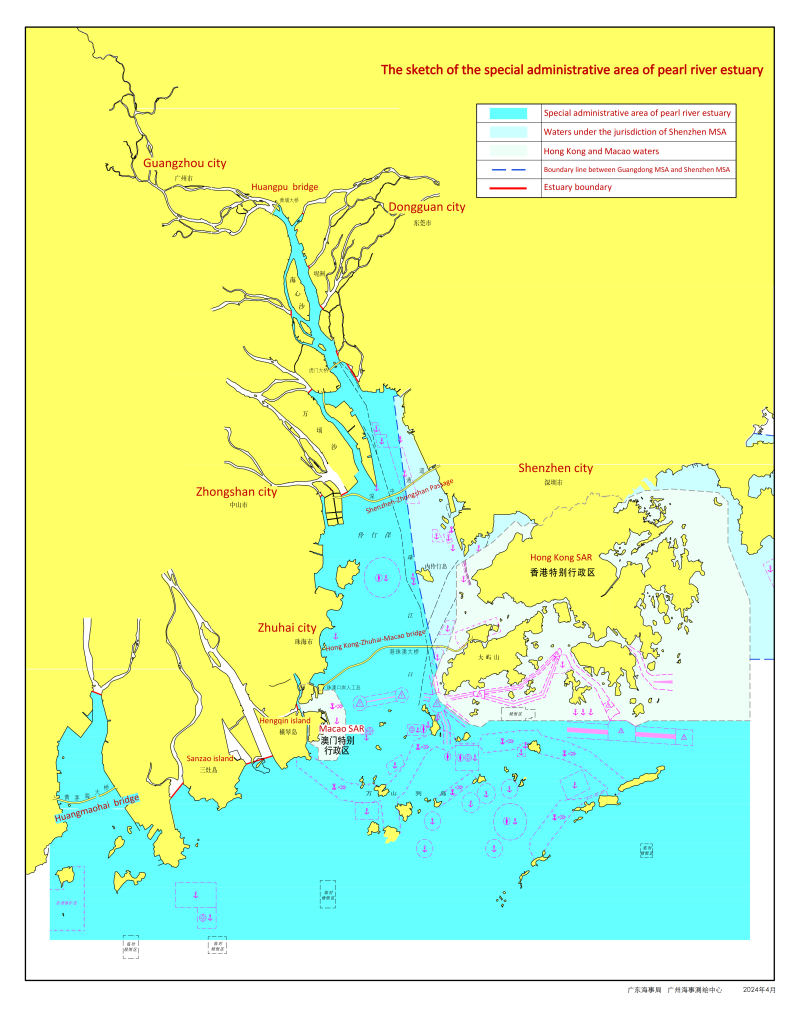
I. The sketch of the Special Administrative Area
II. Requirements for safe navigation of ships
1. The regulation applies to ships engaged in navigation, berthing, and operations in the Special Administrative Area and other activities related to marine traffic safety.
2. Ships shall maintain sufficient UKC (under keel clearance) during navigation, berthing, and operations in different waters and passages.
3. When navigating along the route, ships shall navigate as close as possible to the outer edge of the route on her starboard side, if it is safe and feasible. Whereas ships navigate near the outer edge of the route shall maintain their courses in accordance with the traffic flow on the adjacent route.
4. When joining or leaving the route, ships shall give way to other ships that navigate along the route.
5. Before crossing the route, ships shall check the surrounding environment and ensure that there is no obstruction to other ships’ navigation before proceeding, and shall follow the below rules:
a) Proactively avoid ships navigating along the route;
b) Sound one long horn before crossing and take measures, such as flashlight warnings to alert other ships during night time;
c) When crossing a route, ships are recommended to navigate vertically to the route or traffic flow as much as possible and avoid crossing through the bow of other ships.
6. Ships shall avoid encountering each other at bends of the route.
7. Ships are prohibited from overtaking other ships in the southern section of the Dahaozhou route (south of the Huangpu Bridge), the northern section of the Chisha route (north of the turning point of the Chisha Channel), the Xinsha route, the Lianhuashan East route, and the Lianhuashan West route. When navigating in the Chuanbi route, as far as it is safe and practicable, ships shall avoid overtaking other ships by going outside of the route.
8. Ships shall avoid turning around at the bifurcation area of river mouths or narrow or curved segments of the route.
9. Ships shall comply with the speed limit rules published by the maritime administrative authorities during navigation.
10. When the visibility is poor, ships shall keep engines and anchors standby, navigate with great care under safe speed, strengthen the lookout, communicate with nearby ships, and sound the fog signals in accordance with relevant regulations.
11. Ships of 50,000 DWT and above shall have their M/E, rudders, communication and emergency equipment tested in advance to ensure that they are in good technical condition before entering the outbound route of Guangzhou port and the main route of Zhuhai Gaolan port.
12. Ships are prohibited from sailing through non-navigable bridge spans. Before passing through the bridge, ships shall choose the suitable bridge span and retain sufficient air draft according to its tonnage and technical dimensions of the navigable bridge spans.
13. Ships shall not enter into waters within 1,000 meters on both sides of the axis of the non-navigable bridge spans of the Shenzhen-Zhongshan Passage and the Huangmaohai cross-sea Passage without prior permission.
14. Ships shall avoid entering into waters of offshore wind farms and marine pastures.
III. Our suggestions
1. Ships are recommended to conduct self-check of the mechanical and electrical equipment before entering the Special Administrative Area. When a ship encounters mechanical or electrical failure, crew members shall report to local MSA or vessel traffic service centre (VTS) immediately via VHF or other possible means with detailed information including the ship’s name, position, the need for rescue, and other emergency situations so that measures can be taken by the local authorities accordingly.
2. Ships should fully comply with relevant provisions of COLREGS 1972 and Safety Management System, ensure there is proper and sufficient lookout, keep a safe speed and take early avoidance actions.
3. In case a collision incident occurs or is suspected to have occurred, if there is human life at hazard, rescue operation shall be immediately carried out, taking into consideration various factors such as safety of the ship and her crew, the surrounding environment etc. Meanwhile, the ship shall contact the nearest VTS/MSA via VHF or their emergency telephone no. +86 12395 as soon as possible. The ship’s agents, P&I Club and its correspondent should also be informed.
4. Ships are suggested to contact their local ship agent in advance for detailed information and guidance in case it is required.