The “12th Annual Capital Link Greek Shipping Forum” was held in Athens on Thursday, May 5th, 2022, as an in-person event, at the Grand Hyatt Athens Hotel, with huge success attracting well over 800 participants. The Forum was organized in cooperation with Nasdaq and the New York Stock Exchange-NYSE. The Lead Sponsor was Tsakos Energy Navigation-TEN LTD.
The Forum was graced by the presence of esteemed speakers H.E. Ioannis Plakiotakis, Minister of Shipping & Insular Policy – Hellenic Republic, Mr. Miltiadis Varvitsiotis, Alternate Minister of Foreign Affairs for European Affairs – Ministry of Foreign Affairs, Hellenic Republic, top level representatives from the international shipping industry, indicatively, Mr. Arsenio Dominguez, Director, Marine Enforcement Division – IMO, Mr. Christos Theofilou, Team Leader – EU Maritime Security Strategy and maritime Common Information Sharing Environment (EUMSS & CISE) and Ms. Magda Kopczynska, Director for Waterborne – Directorate General for Mobility and Transport – European Commission, Mr. Philippos Phillis, President – European Community Shipowners’ Associations (ECSA) & CEO – Lemissoler Navigation, Mr. John Xylas, Member of the Board – Union of Greek Shipowners & President & CEO – Ariston Navigation Corp., Mr. Guy Platten, Secretary General – International Chamber of Shipping (ICS) and Mr. George Alexandratos, General Manager – Apollonia Lines SA & Vice President – Hellenic Chamber of Shipping, Mr. Christos Megalou, CEO – Piraeus Bank and top Greek shipowners, among others: Dr. Nikolas P. Tsakos, Ms. Semiramis Paliou, Mr. Theodoros Veniamis – the former President of UGS – Mr. Petros Pappas, Mr. George Angelopoulos, Mr. Paris Dagnis, Mr. Harry N. Vafias, Mr. Panos Laskaridis, Mr. John Xylas, Ms. Ioanna Prokopiou, Mr. Leon Patitsas, Messrs. Nikos & George Tsavliris, Mr. George Gourdomichalis, Mr. George Alexandratos, Mrs. Irene St. Daifas.
The most important current market issues were discussed, such as the impact on world trade and shipping due to the recent geopolitical reshuffles, sanctions and their impact on trade and shipping, technology, the latest developments in shipping regulations, and green shipping and financing.
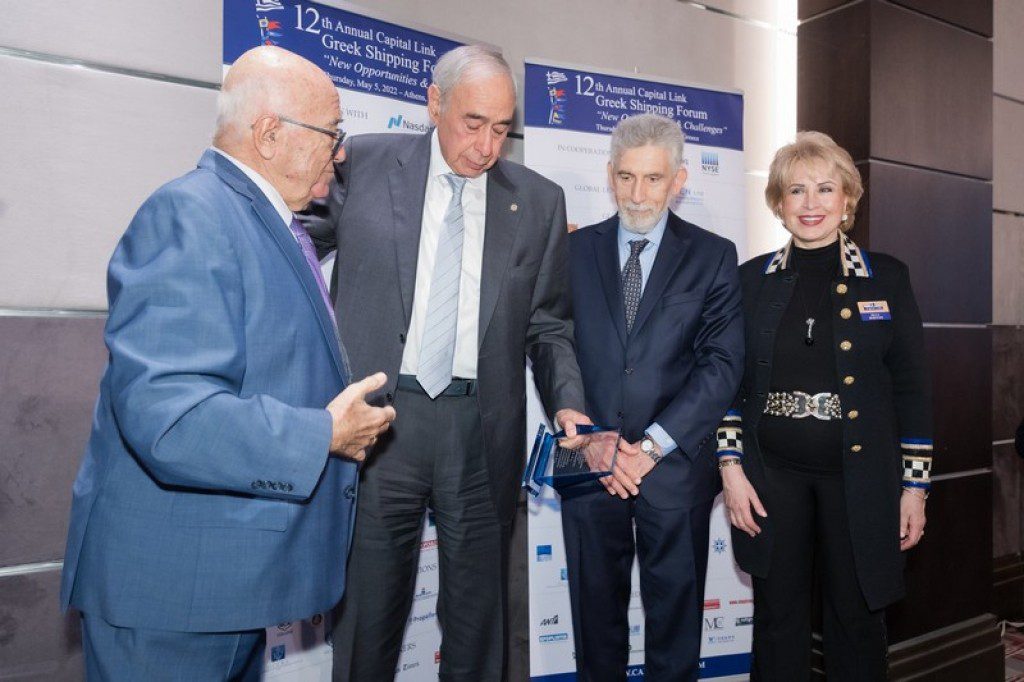
In the context of the forum, Mr. Simeon Palios, Founder & Chairman of Diana Shipping, received the “2022 Capital Link Greek Shipping Leadership Award”, for his outstanding contribution to the shipping industry of Greece after a particularly warming introductory remarks by Capt. Panagiotis Tsakos, Founder & President – Tsakos Group.
Greek shipping remains critical to the maritime economy, constituting approximately 20 percent of the world’s shipping fleet. Despite the volatile markets and economic downturn, Greek shipping professionals have consistently adapted to constantly shifting conditions, seeking growth and opportunities rather than yielding to the circumstances.
FORUM OVERVIEW & STRUCTURE
The event focused on three main areas:
options & strategies, marine engines & fuels and the transformational impact of technology.
mechanisms and private equity.
With 800+ participants, attendees experienced an insightful networking forum connecting them to the shipping industry’s key players, including influential members in the financial community, such as commercial and investment banks and other Bodies and Organizations. This one-day conference is known for its large attendance by shipowners and its rich informational content.
PANEL & PRESENTATION TOPICS
OPENING REMARKS
Presentation By: Mr. Nicolas Bornozis, President – Capital Link
Mr. Nicolas Bornozis, stated in his speech: “I want to thank of you all for being here today. We are delighted to be able to see you all in person following the pause of the last 2 years due to the pandemic. Let’s begin the program and listen to today’s very insightful presentations and panel discussions. This year’s Forum will examine all the major issues concerning the shipping industry, such as, the consequences of the Ukraine war to global trade and shipping, the sanctions and their effects on trade and shipping, technology, the latest developments pertaining to the regulatory and statutory requirements, green shipping and finance.
We also have the privilege to have with us as Keynote Speaker of the Forum, Minister of Shipping and Insular Policy, of Greece, Mr. Ioannis Plakiotakis, whom we thank very much for his presence and speech. Furthermore, it is with great pleasure and honor that we present Mr. Simeon Palios, Founder & Chairman of Diana Shipping with the “2022 Capital Link Greek Shipping Leadership Award”, in recognition of his outstanding contribution to the shipping industry for well over 50 years, with Capt. Panagiotis Tsakos, Founder & President of Tsakos Group, his lifetime friend, making the introduction.
Mr. Bornozis thanked all sponsors, media partners, supporting organizations and delegates for their invaluable contribution in making this yet another successful event, as well as for their presence at the Forum.
SETTING THE STAGE – SHIPPING MARKETS UPDATE & OUTLOOK
Presentation by: Mr. Peter Michael Christensen, Head of Research – Cleaves Securities AS
Mr. Peter Michael Christensen, in his speech he stated: “A prolonged period of underinvestment, that started in 2016, could lead to the 2020s being one of the best decades in a long time. There will be an uptake in newbuild contracting in the next couple of years, although prices for steel and other materials are up. The problem is that there are no profitable green fuel options for shipping at the moment. Except for some Japanese yards, yard capacity is looking tight and steady growth is observed concerning the demand for dry bulk shipping, whose share index could rise 38% by the fourth quarter of 2023. As far as oil tankers are concerned, the demand will continue to grow, driven by increased energy consumption in developing Asian economies.”
SHIPPING – NAVIGATING THROUGH GEOPOLITICAL TURBULENCE
Introductory Remarks by: Ms. Yuri Ann Arthur, Commercial Counselor, Athens – U.S. Department of Commerce
Ms. Yuri Ann Arthur, in her speech she stated: “It is a pleasure to be here representing the US embassy, bringing you Ambassador Pyatt’s remarks on his behalf. Syros is the Ambassador’s favorite Greek island and it is thanks to ONEX transforming the local shipyard from a failed project with hundreds of unpaid workers to a sustainable business. The US flag flies there, and we can safely call it a landmark of US – Greek relations. ONEX continues its work, having proposed an offer for Elefsina’s shipyards, aiming to bring in new business from the commercial and defense sectors, including plans for green transformation and synergies with local business. We are also looking forward to the privatization of the port of Alexandroupolis, an investment that combines geopolitical stability and economic growth. Is this the peak of our bilateral relations? We believe this upward trend will continue. There’s no denying that US interest in Greece at the moment is strong, and there is bipartisan support, thanks to Greece’s role as a pillar of stability in the region and its ubiquitous stance in the right side of history.”
Moderator: Mr. Michalis Pantazopoulos, General Manager Greece – Liberian Registry (LISCR Hellas)
Panelists:
Mr. Michalis Pantazopoulos, General Manager Greece – Liberian Registry (LISCR Hellas), stated: “After a couple of years of remote operations, we are back in live action. While we are still trying to recover from the pandemic, the energy crisis resulting from the Russia – Ukraine war has had an enormous impact. Shipping has been proven flexible in the past, adapting to geopolitical challenges such as piracy, sanctions, and regulations. We are trying to accommodate the many stakeholders of the shipping industry in a fluid environment. The silver lining is that turbulence can create opportunities for reward.“
Mr. Miltiadis Varvitsiotis, Alternate Minister of Foreign Affairs for European Affairs – Ministry of Foreign Affairs, Hellenic Republic, stated: “Geopolitics is back on the frontlines of the news, as we are witnessing a power struggle in Europe for the first time in decades, something that was impossible to predict. Russian’s invasion has caused a humanitarian disaster with thousands of refugees and displaced persons. Furthermore, we are seeing a great shift in the Union’s policies, finally reacting as a true geopolitical actor, with the quick adoption of five packages of sanctions so far. New countries have expressed an interest in joining NATO, while the EU also strengthens its defense capabilities. Also, in recent national elections, in France for example, the communal perspectives prevailed over the nationalistic ones. We are expecting turbulences in oil prices from upcoming sanctions, which are being negotiated, but this is necessary if we are to stop the financing of Mr. Putin’s war.”
Mr. Christos Theophilou, Team Leader – EU Maritime Security Strategy and maritime Common Information Sharing Environment (EUMSS & CISE) – European Commission, stated: “The EU has a strong sustainable blue economy agenda, which is designed to contribute to the Union’s goals, including a 90% reduction of greenhouse gas emissions and decarbonizing maritime transport. The aim is by 2030 to have zero emissions vessels, to boost the production alternative fuel ships with the necessary infrastructure, supporting the retrofitting of vessels and guaranteeing a strategic advantage for Europe’s capacity to build and produce in the future. Lastly, freedom of navigation, border control, respect of international law, particularly UNCLOS, are objectives that are linked to our common security and defense operations.”
Ms. Kirsty MacHardy, Partner – Stephenson Harwood, stated: “The purpose of the sanctions imposed on Russia is to pressure them and cripple their economy. I think they are necessary, although there is no one in this room that hasn’t been affected by sanctions. There’s also a direct impact on shipping, such as the ban of importing certain goods into the Union, and a ban of Russian oil and refined oil products importation is being discussed in Europe. The excessive reliance of certain EU member states is what is partially undermining the effectiveness of these sanctions.”
Mr. Andreas Hadjipetrou, Managing Director – Columbia Shipmanagement, stated: “The overall uncertainty in shipping has created more opportunities for owners and operators. I believe Greek shipping will be able to position itself positively. The last two years have been a perfect storm; sanitary crisis, sanctions, geopolitical instability all have created an ever-shifting day-to-day work environment.”
NAVIGATING THE MARINE FUEL LANDSCAPE – PATHWAYS TO GREEN SHIPPING
Video
Presentation by: Mr. Georgios Plevrakis, Vice President for Global Sustainability – ABS
Mr. Georgios Plevrakis stated: “Decarbonization is a huge challenge for shipping. During the last two years we have seen policies on a global scale that have affected our view of the future. The EU has imposed the Fit for 55 measures which are added on top of the IMO’s announced objectives. It’s been made clear that the energy transition will be based on the hydrogen and carbon value chains and a holistic life cycle analysis (LCA), in order to calculate the true carbon footprint of our activities. If production is included in that calculation, even with the use of green fuels, there are elements contributing to greenhouse emissions. A significant increase of renewable energy production would be required. Compared to current worldwide /solar energy production, a 3-4 times increase is needed, just to cover shipping decarbonization.”
SHORT SEA SHIPPING – Leading the Green Revolution to Zero Emissions
Moderator: Mr. George Dimopoulos, Principal Specialist, Head of R&D & Advisory Unit Maritime – DNV Maritime
Panelists:
Mr. George Dimopoulos, Principal Specialist, Head of R&D & Advisory Unit Maritime – DNV Maritime, stated: “Decarbonization is a fact, it is happening around the world. However, the right mix of technology, instruments, regulations, and measures to achieve the environmental goals without compromising our business needs to be addressed. We are here to explore and debate these changes, with an emphasis on short sea and coastal shipping. Technology is advancing, the future is here, but so far this technology isn’t evenly distributed across shipping sectors.”
H.E. Frode Overland Andersen, Ambassador of Norway to Greece, stated: “It is an honor and a pleasure to be here and share the Norwegian take on this subject and how what we’ve learned could be applied in the case of Greece. In 2014, Norway started the electrification of its ferry industry. There were multiple reasons: a business slump in our local shipyards, the anticipation of legislation changes that would favor low emission vessels, the necessity to show strong political will, and having a large domestic market. All of which are common points between Norway and Greece. We built our first electric ferry in 2015. Today, a large percentage of our 200 ships are electric or hybrid and they are multiplying at an extremely rapid pace. To mitigate the transition’s cost, the government and the industry must make sure the customers don’t end up carrying that burden. A mix of cooperation and coercion is needed. Having been in Greece for three years, there is this belief that us Norwegians did this to be altruistic. This is not the case. Although change is painful in the short term, this will benefit our industry in the long term. By investing in our future, we’ve built a new industry that we are now exporting to the rest of the world.”
Mr. George Alexandratos, General Manager – Apollonia Lines SA; Vice President – Hellenic Chamber of Shipping, stated: “At the Hellenic Short Sea Shipping Association, as official advisors to the State in terms of the maritime sector and the topic of transition, I must say we’re very much concerned. Are we witnessing a Greek revolution towards green shipping or is this a vague attempt at transition? Are zero emissions a feasible task or just a utopia? The challenge is that we are facing many unknown factors, nothing depends on ship-owners except implementation, and it is difficult to know beforehand which system to rely on in the future. One advantage of short sea shipping is that it does not require particularly high speed.”
Mr. Ioannis Chiotopoulos, SVP, Regional Manager – South East Europe Middle East & Africa Maritime DNV AS, stated: “We are trying to increase awareness and involve all the different stakeholders to lead these transition efforts. Willingness is very important but not as important as collective willingness, which is rare in Greece. The technology and the know-how exist here in Greece, the solutions are right in front of us. However, in every change there are winners and losers, and someone always ends up paying the bill. If we want a country to be proud of, without heavily polluting vessels around our beautiful islands, initiative needs to be taken immediately.”
Prof. Dimitrios Lyridis, National Technical University of Athens, stated: “The problem in Greece is the lack of coordination in our approach. Regarding electric shipping, certain factors hamper their adoption in short sea shipping. Two major problems currently exist: first, legislation regarding the selling of electricity is prohibiting the owner of the grid from selling energy to ship-owners. The second challenge is funding such a large investment. Companies are barely making it right now, and a transition would require close to a 50% state subsidy or grant. Yet shipping is not allowed to be financed by the state with few exemptions or derogations. Direct investment legislation needs to be addressed at the EU level.”
EXAMINING ESG – HOW THE LANDSCAPE IS EVOLVING
The panel took an in depth look at how the maritime conversation around ESG is changing due to industry expectations, societal pressures & the regulatory environment. What does ESG means for shipowners, charterers, lenders, investors and insurers? How are they navigating transparency requirements and what is the best practice for reporting? This session focused on how different stakeholders perceive the risks & opportunities associated with ESG and what this means for shipping in the short, medium & long term.
Moderator: Mrs. Anthi Miliou, Head of Sales, In Service – Lloyd’s Register
Panelists:
Mrs. Anthi Miliou, Head of Sales, In Service – Lloyd’s Register, stated: “Achieving ESG goals requires active corporate analysis with a focus on the best environmental, social and governance practices. Finance is greatly influenced as well, and the perception seems to be that companies with higher ESG score rating have better access to it. According to studies, this also leads to better performance.”
Ms. Kiara Konti, Associate Partner, Climate Change and Sustainability Services – EY, stated: “In the last 2 years, we’ve witnessed strong momentum in achieving convergence in terms of setting standards. There was quite a lot of confusion in the past, but two recent prominent events have streamlined things: Cop 26 in Glasgow and the setting of common European standards: these initiatives help companies streamline their processes. The concept of material case by case analysis is gaining momentum, since ESG standards differ depending on the sector. Companies need to take into consideration both how they affect sustainable development and how climate crisis, for example, in turn impacts the corporation itself.”
Mrs. Charis Plakantonaki, Chief Strategy Officer – Star Bulk Carriers Corp., stated: “In the past, ESG was just part of our action plan. Nowadays every aspect of business has to be integrated in that specific strategy. Investors are interested in our corporate governance and sustainability targets. Attracting top tier talent also depends on our ESG transparency. Compliance with IMO targets for instance has become an indispensable part of our strategy. Obligatory environmental regulations as set by the Ballast Water Treatment Convention, the sulfur clap and more will ensure that the environment will continue to be on the spotlight. The social part has moved higher up in the agenda, since companies can’t achieve good performances without safe and happy employees. The concept of well-being is gaining more and more traction.”
Mr. George Wells, Commercial Head for Structured Deals and Decarbonization – Cargill, stated: “ESG has been central for us for a while, and we’ve set ambitious goals. Shipping being essential to our way of life, we are seeing a strong push coming down the supply chain to set higher standards particularly as far as safety is concerned. We need to be transparent and consistent when talking about emissions. The big change I’ve seen in the industry’s approach is that it has become a lot more collaborative between owners, operators, fuel suppliers, etc. Only together with the wider industry can we improve and solve problems, ahead of this transformative decade.”
Mr. Theodore Jadick, Managing Director, CEO & President – DNB Markets, stated: “We are giving a thorough and exhaustive look at our client base and their governing structure is becoming an increasingly important factor. Assessing where our clients stand at the scale is an important step. All companies are doing something about ESG, it is no longer a choice as it directly affects their access to capital. We try to focus on clients that are meeting requirements and performing well. It already is an important consideration and its influence will only increase in the future.”
Mr. Vangelis Rousos, Vice President, Commercial – Tufton Asset Management, stated: “We are witnessing an evolution, a natural progression from CSR, that was the acronym used prior to ESG. Shipping has been adapting to environmental regulations for a while. Climate change discussions are now taking center stage in the political arena and additional regulations could cause some abrupt consequences. We have to adjust; we are therefore applying ESG principles in a more formalized and centralized way. In a nutshell, we apply the UN principles for responsible investing in each stage of our activities, be it fundraising, evaluating investments etc.”
BANK FINANCE
Video
Moderator: Mr. Jasel Chauhan, Partner, Head of International Finance – Hill Dickinson
Panelists:
Mr. Jasel Chauhan, Partner, Head of International Finance – Hill Dickinson, stated: “We’ve been based in Greece since 2009 and all I can say is that it hasn’t been boring. In this panel, we will address how the last couple of years played out for finance. It is important to notice the transitions, from a healthcare crisis to vaccines, from peace time to war, and how this transformative time has affected us all.”
Mr. Channing Wang, Regional Manager – Bank of Communications Financial Leasing (Europe) GmbH, stated: “The last years have been difficult, representing a tough time in everyone’s lives. Still, there are some good news to be found: The Chinese leasing companies’ shipping portfolio grew significantly, now representing 16 billion dollars. We can safely say we now have an important share in the market. The volatility of the shipping market imposes the need for diversity in terms of financing. We are offering increased flexibility in a context of intense competition.”
Mr. Philipp Wuenschmann, Global Head of Shipping – Berenberg, stated: “This is a good time for shipping finance. As many of you know we have strong capital behind us. In the absence of banks and private equities we were there to help refinance shipping activity. Now portfolio sales seem to be over, we are thus entering a new era. We are incorporating new business sources, and just had a very busy first quarter, through the financing of optimization, the renewal of fleets and their age profile, as well as the purchasing of secondhand vessels.”
Mr. Vassilios Maroulis, Managing Director Head, EMEA Shipping, Logistics & Offshore – Citi, stated: “We are used to the ups and downs and have a strong healthy portfolio at the moment. We are corporate financiers therefore fluctuation in terms of asset value impacts us. That said, our global portfolio is now larger than 10 billion. We are selective in terms of who we bank, we require specific levels of activity. Going forward, apart from this extremely difficult, terrible situation with the war, I do predict a positive outlook for the foreseeable future. We are cautiously optimistic I would say.”
Mr. Hugues Calmet, Senior Vice President, Head of DNB Athens Representative Office – DNB Bank, stated: “Banks have the capacity to lend at the moment. We see an increased diversity in capital sources. Going forward, due to the high prices and lack of new building we probably won’t have a lot of activity. There is a number of dark clouds up ahead, including inflation and geopolitical tension; ESG is high on the agenda and everyone needs to take that into consideration.”
Mr. Konstantinos Petropoulos, General Manager, Structured & Shipping Finance – Piraeus Bank, stated: “It’s great to be among familiar faces after two years of speaking directly to a computer. We see a large demand for many new shipping loans. Despite the challenges that local banks faced during and after the financial crisis, including capital constraints, high percentage of non-performing loans, and the healthcare crisis after that, our foothold remains strong. We offer a comprehensive range and did expand our services in the last years with our first shipping bonds. We are always looking for well-structured opportunities. Major transformations on the global economy are taking place, first with covid and now with Ukraine. The long-term trend that is starting to form is moving from globalization to regionalization, and prioritizing resilience over efficiency.”
GREEK BANKS AT THE FOREFRONT OF SHIP FINANCE
The Greek Bond Market – An Innovative Funding Mechanism For Shipping Companies
Remarks by: Mr. Christos Megalou, CEO – Piraeus Bank
Mr. Christos Megalou stated: “Corporate bonds have been a focal point of the Greek capital market during the last five years, with strong investor’s interest and remarkable retail investors participation. 2021’s momentum was maintained in the beginning of 2022 although activity has temporarily halted against the backdrop of the uncertainty caused by the war in Ukraine. The key benefits for shipping issuers are the diversification of funding sources, the fact that the instrument is appealing to both retail and institutional investors, and that it reaches a broad new market.
Three bond issues from shipping groups have taken place in ATHEX so far. We believe this market will continue to grow, creating new opportunities, and we encourage everybody to examine this alternative source of finance. It’s in our DNA to be active in capital markets and investment banking, we are therefore always interested in new instruments, particularly to help an industry that is extremely important for Greece, including in terms of its contribution to GDP.”
KEYNOTE ADDRESS:
Keynote Address, H.E. Ioannis Plakiotakis, Minister of Shipping & Insular Policy – Hellenic Republic
H.E. Ioannis Plakiotakis, Minister of Shipping & Insular Policy – Hellenic Republic, stated: “It is a great pleasure for me to address this year’s Capital Link shipping forum. The past months have shown how sensitive shipping is for the resilience of our supply chains. The maritime sector is one of the most flourishing sectors of the Greek economy, representing, in 2021, 9,6% of our national GDP, while Greece remains Europe’s largest ship-owning nation, making up 59% of the EU fleet. It is no exaggeration to underline that Greek shipping is vital for the totality of the European Union’s international trade. With security concerns on the rise, Greek ships are equally crucial in assuring adequate energy supply for Member States.
Ladies and gentlemen, we are living in challenging times, with recent developments derailing and rescheduling our priorities. In 2022, we need to set a strong foundation for recovery. The main challenges include decarbonization, as shipping does its part in the fight against climate change. For our goals to be achieved, availability of green fuels needs to be secured; Research and development needs to be intensified, and Greece will continue to shape the relevant environmental regulations.
In terms of governance, the shipping industry will only operate effectively if the relevant standards are adopted on an international basis. UNCLOS and IMO are the institutions that need to be respected and are responsible for guaranteeing a bright future for the shipping industry.
Lastly, it needs to be acknowledged that we’ve been through a challenging period for shipping finance. Lack of funding from traditional banking and the covid recession have caused problems for ship operators. Greece believes that a blend of financial instruments will be needed for what lies ahead, with public financing fully addressing the particularities of the industry and the need to generously support shipping’s green transition.”
LUNCHEON&AWARDS CEREMONY2022 CAPITAL LINK GREEK SHIPPING LEADERSHIP AWARD
The highlight of the event was the presentation of the “2022 Capital Link Greek Shipping Leadership Award” honoring
Mr. Simeon Palios, Founder & Chairman – Diana Shipping, recognizing his 50 year long-standing achievements and contribution to the Greek and Global Shipping Industry, his thought leadership and pioneering initiatives.
In the course of all these years, as he himself has stated in the past, he has tried to act with transparency, clarity and discipline. Mr. Palios is, one of the most important shipowners in the country, a Chios native, who with his excellent administrative skills has managed to keep his business alive despite the decade long economic crisis that has hit Greece and shipping, while other companies have been significantly affected.
INTRODUCTORY REMARKS:
Capt. Panagiotis Tsakos, Founder & President – Tsakos Group
Capt. Panagiotis Tsakos delivered a particularly moving speech, introducing Mr. Palios, stating “Very few things in life would have given me more pleasure than introducing Mr. Simeon Palios whom I’ve known for many years. I wish to congratulate Capital Link for their excellent choice for the recipient of this year’s prestigious award.
Mr. Palios’ shipping roots can be traced in the island of Chios. In 1971, Simos founded Diana Shipping Agencies S.A. and since 2005 became CEO and Chairman of Diana Shipping Inc., a publicly listed company in the United States. His vast and deep experience in shipping, especially in technical and operational matters, helped him throughout his career. If there is one accomplishment that he treasures it is his philanthropic and charitable work. Furthermore, Simos’ deep patriotism has been manifested often, while his love for Chios is legendary. My warmest congratulations Simos, you more than deserve this award.”
HONOREE:
Mr. Simeon Palios, Founder & Chairman – Diana Shipping
«2022 Capital Link Greek Shipping Leadership Award»
Many came to honor Mr. Palios, among them his entire family, friends and important shipping executives representing the elite of the shipping community.
In his speech, Mr. Simeon Palios thanked everyone for their presence in this emotionally significant moment, and stressed the following: “Sincere thanks to the organizers Capital Link for this prestigious award. I have tried to conduct my business affairs with decency and transparency, ever since I founded Diana Shipping Agencies over 50 years ago. My principles further included discipline and clarity of thought.
I always sought out new ideas for finance, which eventually led to the public equity markets. Since my company entered the New York exchange, I have no doubts it was the right thing to do for its long-term survival and growth. From the early days, I managed to attract and work with good and trusted partners. I am also a firm believer that luck does play a huge role in the success of any venture, and at Diana Shipping we have enjoyed our fair share of good fortune. I am above all else grateful for my family, my wife, children, and grandchildren. Thank you once again for this honor and for joining me to celebrate this very special occasion.”
CAPITAL LINK GREEK LEADERSHIP SHIPPING AWARD
The “Capital Link Greek Shipping Leadership Award” aims to recognize the “patriarchs” of Greek Shipping, the personalities who through their renowned long course contributed decisively in the emergence of Greek Shipping in its leading position in the world.
The «Capital Link Greek Shipping Leadership Award» was presented to Captain Panagiotis Tsakos in 2013, to Mr. Periklis Panagopoulos in 2014, to Mr. Lampros Barnavidis in 2015, Vice Chairman of the Baltic Exchange, Trustee of the Lloyds Register Foundation and Managing Director and Global Head of Shipping RBS 1998, to Messrs. Nikolas, George and Andreas Tsavliris, Tsavliris Salvage Group in 2016, to Prof. Costas Th. Grammenos CBE DSc, LRF Chair in Shipping, Trade & Finance, Chairman, Costas Grammenos Centre for Shipping, Trade & Finance, Cass Business School, City, University of London in 2017, and to brothers Messrs. Panos Laskaridis, President, European Community Shipowners Associations; CEO, Lavinia /Laskaridis Shipping Company Ltd. and Athanasios Laskaridis, Chairman and CEO Lavinia Corporation, Lavinia Enterprises Limited and Laskaridis Shipping Company Ltd. in 2018, to Captain Paris Dragnis, Chairman & Founder – Goldenport Group in 2019 and to Mr. George Procopiou, Founder, Dynacom Tankers Management, Sea Traders, Dynagas in 2020.
PANEL & PRESENTATION TOPICS (continued…)
MARITIME POLICY & REGULATORY UPDATE
Moderator: Mr. Alexandros Damianidis, Partner, Assets & Structured Finance Group – Watson Farley Williams
Panelists:
Mr. Alexandros Damianidis, Partner, Assets & Structured Finance Group – Watson Farley Williams, stated: “This panel features experts in their field with the objective to discuss policy and the regulatory framework of the shipping industry. Regulators will have the opportunity to respond to the criticisms and preoccupations of the sector’s representatives.”
Ms. Magda Kopczynska, Director for Waterborne, Directorate General for Mobility and Transport – European Commission, stated: “One thing that any sector and shipping in particular needs are predictability and long-term legislative stability. We need to establish regulations fast, and it is preferable to do so globally, since we are dealing with a global sector. We had situations where legislation was first generated in the EU and then adopted by the IMO and vice-versa. Above all, we need a clear vision, a global framework with specific objectives. The earlier shipowners know the changes they’ll need to implement, the better it will be for everyone involved.”
Mr. Guy Platten, Secretary General – International Chamber of Shipping (ICS), stated: “It’s great to be here in the flesh! I believe there’s more than unites us than divides us, between regulators and the people who must adhere to regulations, since we are striving to achieve the same things. We still don’t know what the new fuels are going to be; for now, shipowners are being called to place bets and predict the prominent fuels in 25 years’ time – I understand their frustration and we need to give them the means to reduce the risk related to their investment. We have major technological and R&D challenges ahead, as well as supply-related difficulties.”
Mr. Philippos Phillis, President – European Community Shipowners’ Associations (ECSA); CEO – Lemissoler Navigation, stated: “Decarbonization is composed of four pillars: A technical pillar, a commercial one, a regulatory one, plus what we call the fourth combustion revolution. It has been said that shipping is entering a transitional period. I believe that it already entered it fifteen years ago. It is no accident that every ship delivered after 2013 already has top of the line engines. Close cooperation between operators and shipowners is necessary to better determine speed, consumption, and other factors. It is important to note the missing part right now, which is ports coordination and direct communication with ships. One of IMO’s targets should be to regulate this particular aspect.”
Mr. Arsenio Dominguez, Director, Marine Enforcement Division – IMO, stated: “Thank you for the kind invitation to share a panel with such extinguished colleagues. The mission of the IMO is to bring everyone together in this global industry and establish one unique standard. This can only be achieved by bringing all stakeholders to the table, including environmental NGOs for example, and cooperate towards a common goal. We may have slight differences of opinion, but in the end we’re all trying to get to the same place.”
Mr. John Xylas, Member of the Board – Union of Greek Shipowners ; President & CEO – Ariston Navigation Corp., stated: “Discussing things amongst ourselves isn’t good enough. We need a larger audience and to be able to influence how the general public thinks about shipping. Regional regulation is problematic by definition in a global economic landscape. On top of that, small and medium enterprises will suffer the burden if any unnecessary or incompatible regulations are adopted at the regional level. Most notably, the ‘polluter pays’ principle must be properly implemented, and fuel suppliers must also share the responsibility.”
ALTERNATIVE FINANCE
Moderator: Mr. Edward S. Horton, Partner, Co-Head of Capital Markets Group – Seward & Kissel LLP
Panelists:
Mr. Edward S. Horton, Partner, Co-Head of Capital Markets Group – Seward & Kissel LLP, stated: “Nice to be here for this discussion about alternative finance. The term describes the new finance methods that emerged about fifteen years ago after the exit of traditional banks from the shipping sector during the financial crisis, although things have evolved massively since then.”
Mr. Timothy Soe, Managing Director – Ascension Finance, stated: “Ascension is a debt provider with offices in New York, London, and Athens. It is clear that much more people have entered the market, which can no longer be categorized as niche. Having worked in large banks in the past, I do not see them as competitors, but rather as entities providing the same borrowers with opportunities to finance different assets. It is possible to split one’s fleet in two and find the appropriate lender on a case-by-case basis.”
Mr. Axel Siepman, Managing Director – BRAEMAR NAVES, stated: “We are helping clients find the best finance solutions, whether it is banks or private equity. Borrowers have toa move within a time frame of weeks in certain scenarios – they need a partner that has the flexibility to react proactively if the investment opportunity deserves it. We only ask what kind of task it is, how fast is the money needed, and for what kind of structure. Alternative finance offers a variety of choice, tailor-made and at the lowest cost possible, although it can be quite pricey if you want leverage.”
Mr. Robbert Jan Souge, Managing Director – Direct Ship Finance, stated: “We are directly financed from our investors in Europe and the US. Our target group includes owners that were left alone during the crisis, mostly family-owned businesses. We see ourselves as a secure financing non-bank… bank. I think our ability to bring flexibility to the table remains the major competitive advantage compared to traditional funding methods. If cash flow seems promising, we are interested. In the good old days when the landscape was still dominated by banks, it was a one-dimensional product. Now, although all panelists here are labeled as alternative financiers, we all offer different products. If you have someone to talk to that understands the business, that translates into added value.”
Mr. Omer Donnerstein, Managing Director – Entrust Global, stated: “Entrust Global launched the blue ocean fund and has managed to raise billions of dollars. In the beginning, we had the view that if want to grow we must view ourselves as investors – a one stop shop – from senior lending to common equity and everything between. We are mostly active on the primary market and recently have expanded into the public market with bonds and other securities. We are part of a large hedge fund, but remain self-managed, which allows us to make investment decisions very quickly.”
Mr. Harris Antoniou, Founder & Managing Director – Neptune Maritime Leasing Ltd, stated: “Neptune is a European maritime leasing company focusing on funding small and medium shipping companies. It pleases me to see that today we have quite a few alternative lenders, maybe leaving the alternative label behind and becoming mainstream. We were established thanks to a cooperation of sponsors with many years of experience in the sector and brough together by our passion for the shipping market, which remains of primordial importance for the global economy, with a preference for younger, greener vessels. We are actively involved in financing transition, including retrofits, one of the important strategies that owners should consider in our minds.”
CAPITAL MARKETS
Moderator: Mr. Robert Lustrin, Counsel – Reed Smith LLP
Panelists:
Mr. Robert Lustrin, Counsel – Reed Smith LLP, stated: “I’m very excited to be here. We met in New York in March and focused on disruption and volatility due to the Russia-Ukraine war. The recent expansion of covid protocols in major cities in China has created significant port congestion and all the problems that result from that. In the panel we have representatives from the American and Norwegian markets, as well as a representative from Nasdaq. Shipping is an industry that needs a great deal of capital. US capital markets are by far the largest and most liquid markets in the world.”
Ms. Christa Volpicelli, Managing Director, Global Transportation Group – Citi, stated: “We are heavily invested in the maritime sector. Citi is a global bank, and we’ve had a consistent presence in shipping over our history, our senior team having over twenty years of experience. This combination is key: a global platform and a specialized team. Selling shipping /debt is a specialized industry and one should pay attention to the differences between companies. Future prospects definitely look exciting, although from our conversations with investors, we understand they are worried about inflation and interest rates going up, as well as expressing concern about a possible recession in the US and Europe next year.”
Ms. Isabella Schidrich, Senior Managing Director – Nasdaq, stated: “We are working with numerous European companies and are currently registering a tremendous influx of new listings. The last two years have been years of incredible growth. Nasdaq provides the trading platform and necessary technology, and we expect to work with more shipping companies going forward. I believe there will be a window of opportunity towards the end of May, as we expect big companies to open the market up. Typically, there is a six-month lag between trends in the US and European markets, making next autumn an interesting period for the European continent. Of course, the current geopolitical situation makes predictions difficult, so we’ll have to wait and see.”
Mr. Ronny Bjørnådal, Deputy CEO – Cleaves Securities AS, stated: “Cleaves is climbing up the ladder, uniquely positioning itself to assist our clients in any way necessary. We focus on corporate financing and are active in the alternative lending space. The market will continue to grow as banks continue to retract. What makes Cleaves unique is being backed by a hedge fund ranked by Bloomberg as one of the best outlets worldwide. To conclude, I agree with what was already said during previous panels: following a prolonged period of underinvestment, the 2020s will probably be one of our best decades in a long time.”
Mr. James T. Cirenza, Managing Director – DNB Markets, stated: “We have been involved in many equity transactions in recent times, it’s been an amazing period for capital markets. From April 2020 to November 2021, the US equity capital markets made more than a trillion dollars. A tremendous twenty-month period. LNG very important to us. Only simple math knowledge is required to see the price has more than tripled in two years. Investor acceptance of LNG is phenomenal and still growing. FSRU investments also feature the best economics one could hope for.”
Mr. Chris Weyers, Managing Director, Head of Maritime Investment Banking – Stifel, stated: “We have positioned ourselves as the large middle market in the US. We offer all same services banks provide, including liability management. Right now, inflation is a huge factor all investors, having reached 8% in the US, driving most companies to not consider this period as a good time to invest. On the positive side, in the stocking markets shipping and oil stocks are way up, although there is still a considerable gap between asset value and stock price.”
STRUCTURED PRODUCTS: Useful Investment Solutions To Reshape Returns And Mitigate Your Portfolio Risk – Leverage On Leonteq Securities Expertise.
Sharp rise in global uncertainty coupled with strained monetary policies (in an attempt to fight off inflation) have led investors facing volatile and unattractive markets. How cautious investors (shipping treasuries and family offices) looking for smooth consistent returns could take advantage of the current environment?
Mr. Alex Pou Cuturi, CEO – Leonteq Monaco, stated: “We’ve been working with Greek shipowners in the last seven years. The key differentiating factor is technology. Tech brings you value, we can issue tailor-made products with no minimum amount. Other key strengths include easy trading access, market expertise, and loan financing. Our celerity is the best, there is no point for false modesty here. We have traded with major actors in Greece, some of which I recognized in this conference. Our presence here serves as a first introduction, and we hope to add value to Greek shipping companies in the future.”
Mr. Hendrick Ketchemen, Director, Structured Solutions – Leonteq Securities, stated: “We are representing the leading investment institution from Switzerland with a global distribution network. We offer a state-of-the-art investment platform developed and maintained in-house, with fourteen locations worldwide. Leonteq has received more than 70 financial industry awards. Furthermore, we are now enlisted in the Zurich stock exchange and aim to become the largest European structured products experts. Product complexity is kept to a minimum, from cash equivalent and fixed income products for shipping treasuries to more bespoke alternatives for shipping family offices.”