Tensions in the Red Sea have escalated once again.
According to Reuters, the Israeli military conducted a rare airstrike on Yemen in the early hours of Monday, targeting the ports of Hodeidah, Ras Issa, and Salif—all under Houthi control—as well as the Ras Kathib power station. Israel described the strikes as a “response to the Houthis’ continued attacks against Israel.”
Per a statement from the Israel Defense Forces (IDF), the operation also targeted the vessel “Galaxy Leader” docked at Ras Issa port. Since its seizure by the Houthis in late 2023, the ship had been retrofitted with radar systems to detect and track vessels in international waters, becoming a key platform for the group’s maritime attacks.
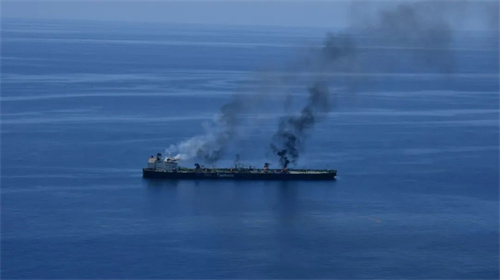
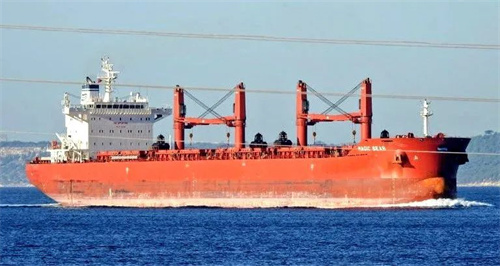
Notably, just hours before the airstrike, another attack occurred in the Red Sea. The Liberian-flagged bulk carrier “Magic Seas,” owned by a Greek shipping company, came under heavy assault approximately 51 nautical miles west of Hodeidah. The attack began with eight small boats firing automatic weapons and self-propelled grenades, prompting the onboard security team to return fire. Subsequently, four unmanned surface vessels (USVs) struck the ship, with two hitting the port side, causing hull damage and a fire. The crew abandoned ship and were later rescued by a passing merchant vessel.
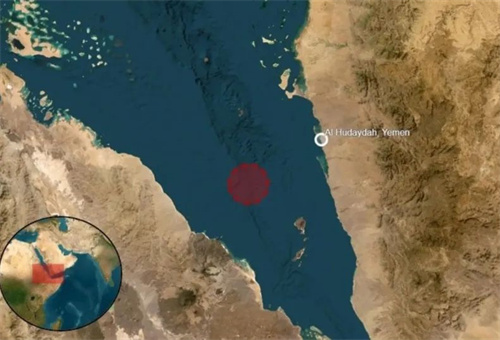
Industry publication TradeWinds, citing informed sources, reported that the “Magic Seas” is managed by Athens-based Stem Shipping, owned by the Bodouroglou family, and was transporting a shipment of steel billets from China to the Baltic Sea.
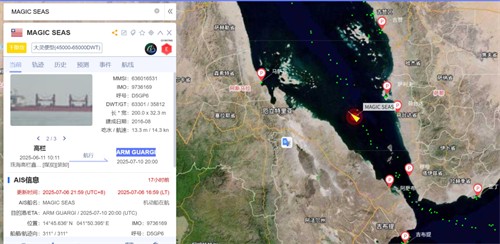
AIS data provided by COSCO SHIPPING Technology’s ship-tracking platform ShipVision showed that the “Magic Seas” had departed from China’s Gaolan Port, with its destination listed as “ARM GUARGI.”
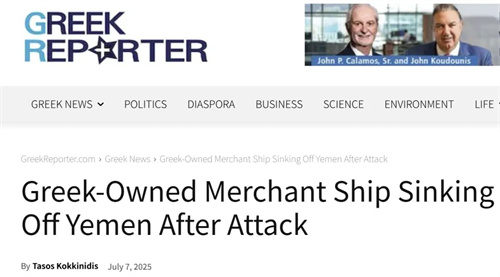
Greek media GreekReporter further reported that the “MAGIC SEAS” is currently sinking due to multiple breaches and flooding. The vessel carried 22 crew members, including 17 Filipinos, one Romanian, one Vietnamese, and three Sri Lankans. At the time of the attack, the ship had not requested escort or protection from the EU naval operation ASPIDES, nor were any naval vessels nearby.
While no group has officially claimed responsibility for the attack, security firm Ambrey noted that the tactics and target profile closely match previous Houthi operations, making their involvement almost certain.
Since the outbreak of the Gaza conflict in October 2023, the Houthis have carried out over 100 attacks on Red Sea shipping under the pretext of “solidarity with Palestine,” sinking two vessels, seizing one, and killing at least four crew members. This wave of attacks has severely disrupted global supply chains, forcing numerous shipping companies to reroute around Africa’s Cape of Good Hope, driving up logistics costs and extending delivery times.
In May, the U.S. announced a pause in military strikes against the Houthis, citing their agreement to cease interference with key Middle Eastern shipping lanes. However, after U.S. airstrikes on Iranian nuclear facilities in June, the Houthis vowed to resume attacks against American interests. Whether they will follow through on this threat remains to be seen.