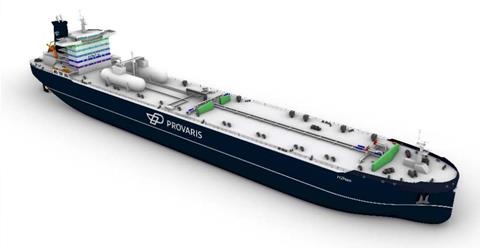
Australia’s Provaris Energy has executed a Memorandum of Understanding (MoU) with UK-based naval architects Northern Marine Management, to develop the company’s first compressed hydrogen (H2) carrier, the H2Neo.
Provaris (previously GEV) and Northern Marine will also review commercial opportunities for a fleet of H2Neo carriers currently under development, to which the parties will then agree on terms for Northern Marine to provide ship management services on a contractual basis.
The 12-month MoU sets out an agreed schedule of activities across multiple phases of the remaining development of the H2Neo carrier, which is targeting Approval for Construction in mid-2023.The deal covers specialist technical and operational services including:
* detailed engineering
* class and Flag approvals
* shipyard selection and newbuild contract
* compliance and certification for safety and operations
* newbuild supervision
* financing, insurance, and operational contracts.
The first H2Neo ship is expected to be operational in 2026, to support the pipeline of hydrogen export projects Provaris is now developing in Australia and potentially Europe.
Provaris has designed two vessels, one with 26,000m3 capacity and one with 200,000m3 capacity. Both have been granted Approval in Principle from ABS. The onboard storage tanks will have an operating pressure of 250 bar. Technical partners include Wärtsilä, Ballard Power systems and /NOV. Provaris has engaged ABS Consulting for the gas dispersion, fire, and explosion safety studies.
Martin Carolan, Managing Director & CEO of Provaris commented: “A partnership with a globally recognised ship manager like Northern Marine is an endorsement of our development for a compressed hydrogen carrier and an indication of the commercial potential as a new class of bulk carrier to support the transport of green fuels, in this case green hydrogen.”
Northern Marine, a member of the Stena AB group, has over 40 years of naval architecture, marine engineering, regulatory and marine quality assurance, and ship management expertise.
Sean McCormack, Ship Management Director, Northern Marine, commented: “We are delighted to have reached an agreement to support Provaris Energy. Given our breadth of experience and market-leading status in managing some of the most innovative newbuild gas carriers currently deployed in the world fleet, Northern Marine is ideally placed to support Provaris with tailored technical and crew management solutions to ensure the safe operation of their GH2 carrier fleet.”
Provaris has engaged Paaras Marine Solutions, a marine structural engineering company based in Singapore, to develop and assess port solutions for both the loading and unloading of compressed hydrogen using the Provaris GH2 carriers, with the scope of the appointment to include:
• Singapore: concept development of an unloading marine jetty facility in Singapore to receive the GH2 carriers for unloading and decompression of compressed hydrogen for local distribution. Concept solutions will include jetty solutions abutting onshore and a facility located offshore with subsea pipeline connecting on onshore distribution network
• Port Melville, Tiwi Islands, Northern Territory, Australia: evaluating existing marine facilities at Port Melville to accommodate GH2 carriers including the loading facilities for compressed hydrogen.
• Barge Storage of Compressed Hydrogen: concept development of a storage barge will be considered for storing compressed hydrogen based on the requirements for intermittent or redundancy in the supply chain.
Concept designs will be included in the feasibility studies in progress for Tiwi H2 and HyEnergy (Western Australia), along with analysis of compressed hydrogen with port operators now underway in Europe.
Provaris says the advantages of compressed hydrogen include that it is commercially viable at low volumes, has a small footprint compared to liquefaction, is the most energy efficient way of transporting green hydrogen and can be loaded via onshore berth facilities or offshore buoy systems.