UK steel policy could keep an interventionist direction during the expected government of Andy Burnham.
Keir Starmer announced on June 22 his resignation as prime minister and leader of the Labour Party, leaving office within weeks. On the same day, former Manchester Mayor Andy Burnham was sworn in as a lawmaker in Parliament after winning a by-election last week. He confirmed his intention to run for leader shortly after Starmer’s resignation, which sets him as the potential UK’s next prime minister.
Burnham’s premiership is likely to reinforce, rather than completely change, the interventionist direction on UK steel policy as he, who has long argued that industrial policy should play a central role in the UK economy, particularly in former manufacturing regions across northern England, advocates for the so called “Manchesterism” approach with public control seen as key for fostering economic growth.
Under Starmer, steel has been explicitly framed as a matter of national security, economic resilience and industrial sovereignty. The government took a decisive step toward nationalizing British Steel, the second-largest UK steel company, with the Steel Industry Bill that last week completed its passage in the House of Commons and has entered the House of Lords.
The government also published a dedicated Steel Strategy on March 19, committed substantial public support for decarbonization and domestic production, and introduced tougher trade protections, although they are still under review.
At Tata Steel Port Talbot, the largest UK steelmaker, Business and Trade Secretary Peter Kyle announced the government’s Steel Strategy ambition to boost domestic production to meet up to 50% of domestic demand for steel, and secure the industry’s role in supporting vital UK sectors like infrastructure, defense and clean energy.
The government outlined the National Wealth Fund as its main mechanism for providing up to GBP2.5 billion of financing for investment in the steel sector, with the Steel Strategy forming a vital part of the government’s activist and strategic approach to British industry.
On March 19, the UK also said that from July 1, 2026, overall quota levels for steel imports will be reduced by 60%, with steel coming into the UK above these levels subject to a 50% tariff. The tariffs are still not finalized, as UK steel end users said the new regime could impose significant financial and logistical pressure on small and medium-sized companies in steel-consuming sectors.
Steel end users said the proposed system would reduce tariff-free import quotas by 60% overall, with some steel product categories facing cuts of up to 90%.
At the same time, tariffs on imports above quota limits could create what the end usersdescribed as a “double hit” for companies already dealing with high costs and fragile supply chains.
While details remain uncertain, investors and industry executives could view a Burnham government as signaling a more activist state role in shaping the future of the sector at a time when, according to the S&P Global UK Consumer Sentiment Index published on June 22, households’ perceptions toward the labor market shifted to the gloomiest since March 2023.
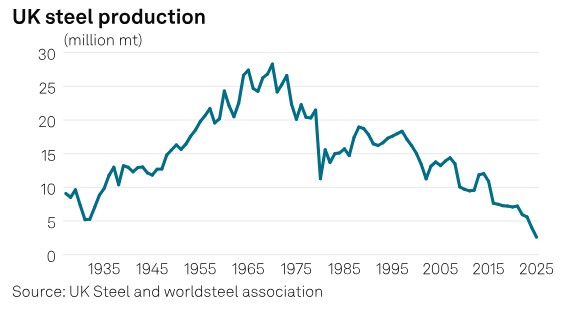
In 2025, the UK produced 2.6 million metric tons of crude steel, supplying only 30% of the UK’s annual demand of 10.3 million mt. Tata UK, the largest domestic steel producer, ceased production in September 2024, marking the end of more than 100 years of blast-furnace steelmaking at the site and the transition to less-polluting electric arc-furnace production.
The UK steel industry has been experiencing a steep downward trend, with crude steel production contracting for several consecutive years. In 2024, output fell 29% to below 4 million mt, following declines of 17% in 2022 and 6% in 2023, due to cheaper import prices sustained by more advantageous raw materials costs, of which labor and energy represent a large percentage.
UK steelmakers face electricity prices up to 25% higher than competitors in France and Germany, adding an estimated GBP26 million in annual costs, with Starmer and Burnham, who have been highly critical of the disproportionately high electricity costs faced by UK steelmakers.
Source: Platts