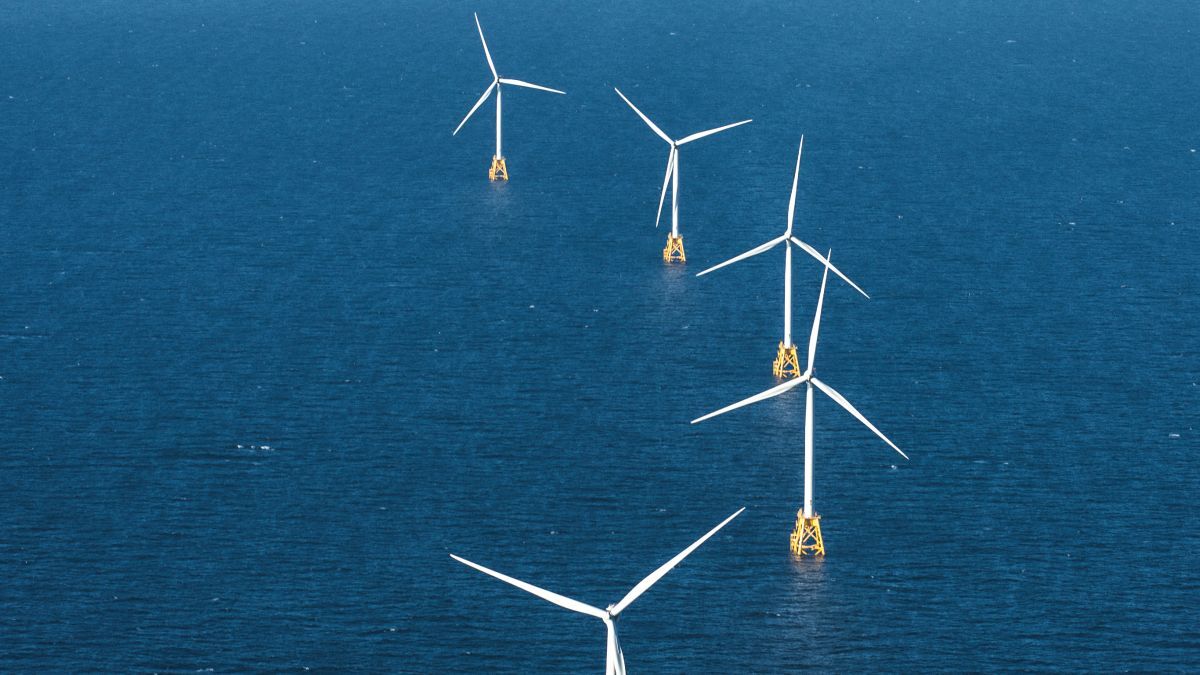
There are only seven offshore wind turbines installed in the US, including five at the Block Island Wind Farm off Rhode Island (source: Ørsted)
Nascent US offshore wind is seen as a ‘huge component’ of the Biden Administration’s goal of reaching 100% carbon-free power generation by 2035
Set against a backdrop of climate change, the Biden Administration’s clean energy goals and Russia’s invasion fo Ukraine, US Energy Secretary told delegates at the IPF Business Network Offshore Wind 2022 conference in April it was “an imperative that we electrify.”
Secretary Granholm cited the Biden Administration’s goal to have a 100% carbon-free power sector by 2035 and 30 GW of offshore wind installed in the US by 2030.
Calling offshore wind, a “huge component” of the Biden Administration’s electrification effort, she said: “We often talk about [offshore wind] being about jobs, and it is. We also talk about this being about our planet, and it is, of course. But right now, this is also about energy security.”
Energy security has come to the forefront since the attack on Ukraine in February. Since the invasion, the European Union (EU) has approved several rounds of sanctions against Russia. On 4 May, EU Commission President Ursula von der Leyen said the bloc will “phase out Russian supply of crude oil within six months and refined products by the end of the year.” The announcement did not include natural gas. The EU imports about 40% of its gas, 35% of its oil and 20% of its coal from Russia.
As outlined in its REPowerEU plan in March, the EU is doubling down on renewables, increasing its energy efficiency and accelerating its clean energy transition as the bloc seeks to wean itself off of Russian oil, gas and coal. The plan also calls for replacing 100 billion cubic metres (bcm) of Russian gas with LNG and gas from non-Russian suppliers, biomethane and hydrogen for power generation. Solar and offshore wind will figure prominently in the EU’s plans.
“77,000 direct and indirect jobs are starting to come to life to create this cluster”
With already 16 GW of grid-connected capacity from about 5,500 wind turbines at 76 offshore windfarms in the EU, Europe is leading in offshore wind deployment. It has set a target of 60 GW to be installed by 2030, and a whopping 300 GW by 2050.
By contrast, the nascent US offshore wind market has just seven offshore wind turbines, with a capacity of 42 MW.
A high-level business forum, co-chaired by Secretary Granholm and EU Commissioner of Energy Kadri Simson, was held during the conference to facilitate a discussion between US and EU private sector and government leaders. This focused on policies needed to accelerate investment in offshore wind projects and the development of an offshore wind manufacturing base domestically, as part of the global supply chain.
During the forum, Commissioner Simsonsaid: “Our day started with the announcement by Gazprom that it is unilaterally stopping delivery of natural gas to some customers in Europe. This weaponisation of gas shows once again that we need to move away from Russian dependence. This is where renewable energy comes in.”
Addressing the supply chain
Citing one of her visits to ports that will form part of the US offshore wind supply chain, Secretary Granholm said, “77,000 direct and indirect jobs are starting to come to life to create this cluster along the Atlantic Seaboard where manufacturing and generation coexist.”
She cited a report, The Demand for a Domestic Offshore Wind Energy Supply Chain, issued by the National Offshore Wind Research & Development Consortium, which aims to lay out a roadmap for the development of 30 GW of offshore wind in the US.
“With international supply chains stretched thin, there is a direct need to develop a domestic supply chain”
The report estimates 2,100 wind turbines and foundations, 11,000 km of cable, five to six wind turbine installation vessels, 10 feeder barges, four cable-lay vessels, and an average annual workforce of between 12,300 and 49,000 will be needed to achieve this capacity.
“With international supply chains stretched thin, there is a direct need to develop a domestic supply chain to meet the national and state offshore wind targets. The domestic supply chain needs to address challenges posed by constrained port infrastructure, a shortage of available installation vessels, and limited domestic manufacturing capabilities for critical-path components,” said the National Offshore Wind Research & Development Consortium in a press release.
In a panel presentation, New York State Energy Research & Development Authority president and CEO Doreen Harris emphasised there was no time to waste to overcome all of the market’s challenges. “2020 is only eight years away from now. Think about the major infrastructure. Eight years is going to go by very quickly,” she said.
Beyond the supply chain, Secretary Granholm addressed the challenge of speeding up the permitting process: “I’m completely obsessed with it. We have got to reduce permitting time.”
Added Secretary Granholm: “We want to develop a roadmap for solutions, that regional transmission and planning and policy and permitting, which is going to allow that 30 GW goal to grow to 110 GW at a minimum by 2050.”
Acreage offshore Atlantic and Oregon
During the IPF Business Network Offshore Wind 2022 event, which was held 26-28 April in Atlantic City, New Jersey, the US Bureau of Ocean Energy Management (BOEM) Director Amanda Lefton announced a call for information on acreage off the central Atlantic coast (Delaware, Maryland, Virginia and North Carolina) and Oregon coast in the US Pacific Northwest. “The calls for information and nominations for Oregon and the Central Atlantic provide an important avenue to solicit information as we identify potential areas that may be suitable for future offshore wind energy leasing,” saidMs Lefton.
The BOEM announcement follows the record-breaking US$4.37Bn New York Bight lease sale, held in February, for six offshore wind leases off the coasts of New York and New Jersey that could yield 7 GW of offshore wind.