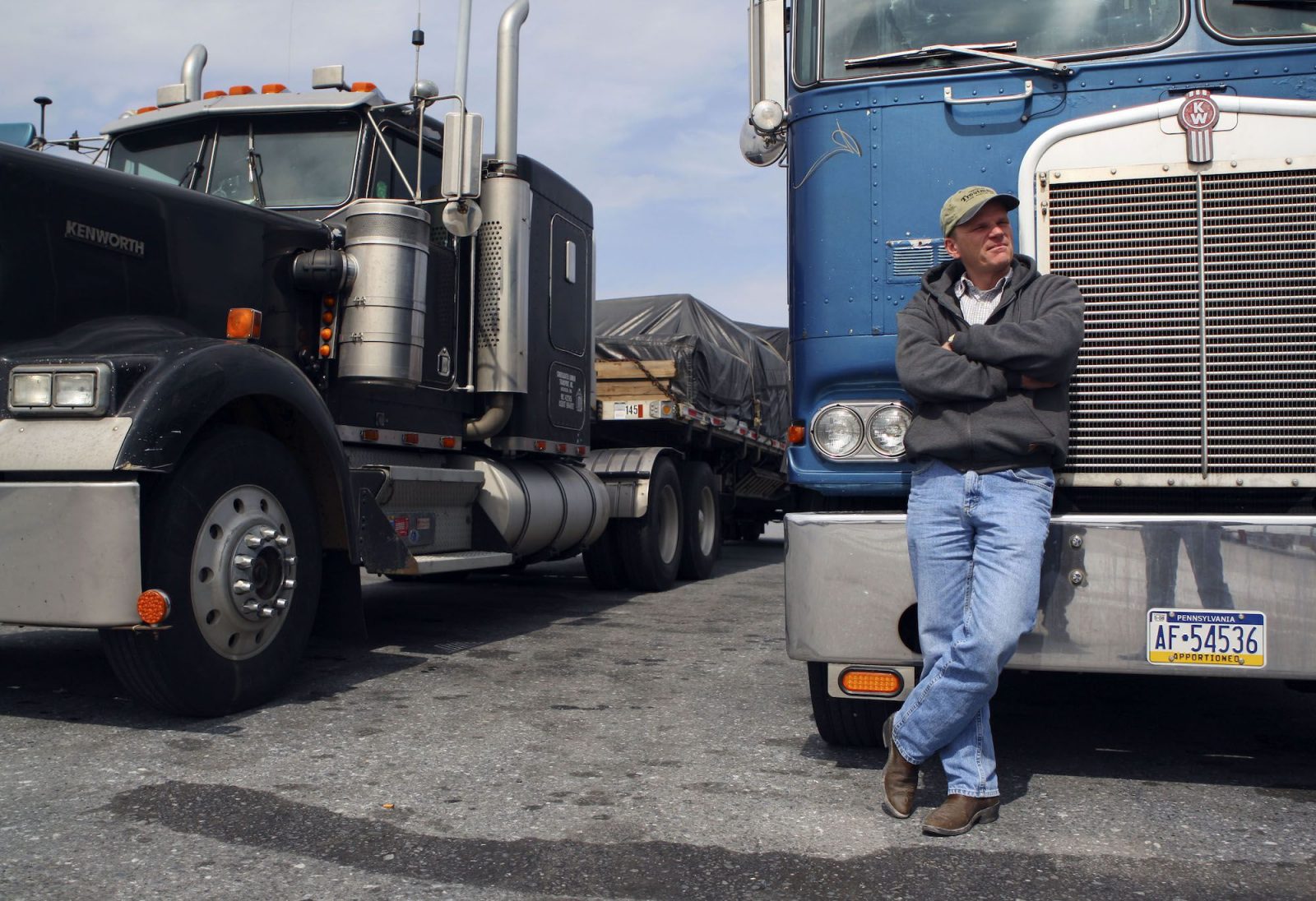
Peeved as heck. In this photo, driver Dixon Smetz joins a rally at a Harrisburg, Pa. truck stop to protest high fuel prices in 2008. (AP /Carolyn Kaster)
Earlier this summer, the U.S. Supreme Court decided not to weigh in on two major issues that have roiled trucking for years.
And for those in the $800 billion trucking industry, the court’s silence has been deafening!
For those of you who were distracted by, ahem, other Supreme Court decisions, you may have missed the trucking angle. The court declined to hear two cases related to freight:
 Subscribe to MODES!
But in declining to hear these cases, the Supreme Court has baffled transportation executives and attorneys. It’s unclear what the law of the land is, because both cases may only apply to the nine Western states (and two territories) that make up the 9th Circuit.
Here is what both cases entailed and what the next steps may be.
But first, let’s talk about F4A
The federal law in both cases was the zestily named Federal Aviation Administration Authorization Act. Those who would rather get to the point call it “F4A.”
The sticking point for F4A is that individual states could not create laws that would conflict with that federal deregulation. No provision can alter the “price, route, or service of any motor carrier … or broker.”
But no state law was as chilling to the industry as California’s AB5 …
California truckers appear to reject AB5, even though the current working scheme for port drivers is pretty rough
 Hundreds of owner-operators blocked terminals at the Port of Oakland in July. (Photo: Clarissa / )
According to the investigation, mega-retailers like Target, Costco and Home Depot all use drayage trucking companies with lengthy histories of labor violations.
No one knows how to treat the workers in trucking
The C.H. Robinson decision ups the ante for trucking ‘nuclear verdicts’
Not anymore. Over the past three to five years, Reliance’s Eichelberger said insurance rates for brokers have climbed around 10% to 20% year over year. For trucking companies themselves, the cost of insurance on a per-mile basis has increased even as the total cost of running a trucking company has decreased.
From 2011 to 2020, per the most recent data from the American Transportation Research Institute, truck insurance premiums increased by nearly 30%. But the overall cost per mile of running a trucking company decreased by 3.5%.
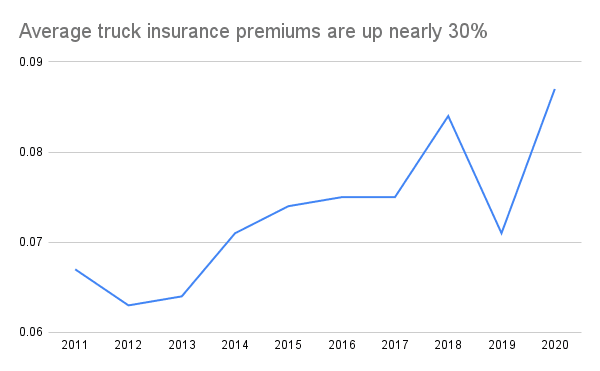 The cost of insurance on a per-mile basis. (American Transportation Research Institute)
“The average size of verdict from 2010 to 2018 increased from $2,305,736 to $22,288,000 — an increase of 967 percent,” said the 2020 ATRI report.
Many of Leizerman’s cases involve spinal injuries, traumatic brain injuries and deaths — and trucking companies that refuse to accept liability. “If you want to avoid a big verdict, then stop denying liability when there’s clear liability,” Leizerman said. “Stop trying to keep an injured person from receiving money for their care.”
Plaintiff attorneys, until recently, did not look at freight brokers as potential defendants for such cases. But as trucking gets more and more fragmented, brokers have become crucial conduits in America’s freight transportation system.
That’s what led retail giant Costco to hire $23.1 billion freight broker C.H. Robinson to find a truck driver for a load of goods traveling from Sacramento to Salt Lake City in 2016. Robinson hired a federally licensed motor carrier that ended up driving unsafely in Nevada, crashing into 25-year-old Allen Miller. Miller was rendered a quadripelgic.
In November, a jury in Nevada will hear Miller’s case. Other cases concerning broker liability are pending in the 7th U.S. Circuit Court of Appeals and 11th U.S. Circuit Court of Appeals. Rena Leizerman, also of the Law Firm for Truck Accidents and part of Miller’s legal team, is (understandably!) someone who says brokers ought to be held accountable. After all, brokers advertise on the basis of finding safe carriers for retailers, manufacturers and farmers.
However, in a statement emailed to , C.H. Robinson passed the buck to the federal government for licensing motor carriers who have no business being on the roadways. Chief Legal Officer Ben Campbell declined to comment on specifics of the case.
“The idea that the Federal Motor Carrier Safety Administration provides only a bare ‘minimum’ safety review of carriers and that shippers and brokers cannot rely on it defies common sense,” Campbell wrote. “This is a tacit admission that the FMCSA has knowingly issued operating authorities to unsafe motor carriers and that it is up to shippers and brokers and the motoring public to figure out which ones they are.”
Where, oh where is our federal government?
Few business leaders jump for joy at the idea of increased regulations, and I would bet that number is even smaller in the trucking industry.
Many facets of trucking used to be highly regulated. However, even as Americans become more and more reliant on truck drivers, Washington has kept mum on issues like worker classification in trucking. There are few guidelines on brokers, too, even though they’re a key node in the transportation system.
“In both of these cases, we are talking about where the line is drawn between a state’s laws governing interstate trucking companies and the federal regulation of these companies,” Johnson said. “There’s just a lot of conflict if you’re of the mind that transportation should move seamlessly among the states and that trucking companies shouldn’t be burdened by individual laws.”