“Even if the Strait of Hormuz reopens, significant uncertainty will remain and continue to shape market outcomes,” says Niels Rasmussen, Chief Shipping Analyst at BIMCO.
Key uncertainties include whether the US/Iran agreement will hold, when the Strait of Hormuz (SoH) will fully reopen, whether ships can return to normal Suez Canal routings, and how US import tariffs will evolve once the current 10% emergency tariffs expire at the end of July.
To reflect this, BIMCO continues to apply two scenarios. The ‘SoH Open’ scenario assumes the Strait of Hormuz reopens in the third quarter of 2026, while the ‘SoH Closed’ scenario assumes it remains effectively closed throughout 2026-2027. In both cases, ship supply is expected to grow faster than demand, pointing to a weakening demand balance regardless of how the situation develops.
Despite the disruption, global container demand has proven resilient. During the first four months of 2026, volumes grew by 5.1% year-on-year, driven by a strong intra-Asia market and exports from East and Southeast Asia to Europe, the Mediterranean and the Southern Hemisphere, while Persian Gulf-related trades declined.
However, risks remain tilted to the downside as higher energy prices weigh on consumer confidence and retail sales, and uncertainty around US tariffs continues to affect trade decisions.
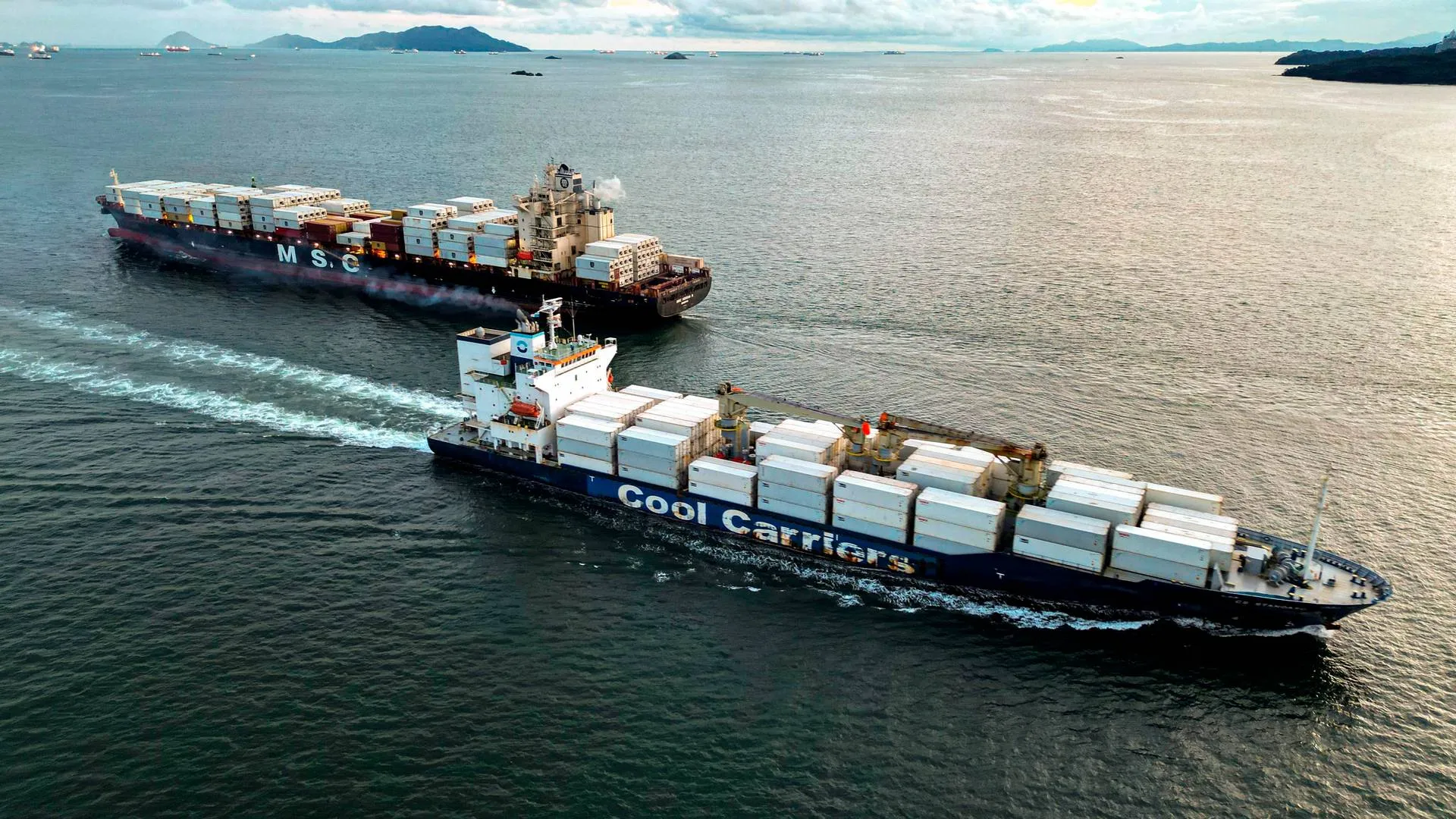
Routing patterns remain critical. Continued diversions via the Cape of Good Hope are absorbing capacity, but stable US/Iran relations could also normalise Red Sea and Suez Canal routings, reducing global ship demand by around 10%, and significantly weakening market conditions.
“While demand has so far been resilient, supply continues to expand rapidly, driven by the large order book and very limited recycling,” says Rasmussen.
Contracting continues to drive the order book to new record highs which combined with very low recycling is set to drive strong fleet growth. Deliveries of around 4.4m TEU are expected during 2026-2027, contributing to total fleet growth of 12.7% between the end of 2025 and 2027.
Short-term market conditions have tightened. Uncertainty around tariffs and bunker costs has triggered front-loading of cargo, particularly into the US, pushing freight rates sharply higher. The Platts Container Index has risen by 80% over the past 30 days to its highest level since April 2022.
Looking ahead, these effects are unlikely to last. In the ‘SoH Open’ scenario, the balance in 2026 may remain broadly in line with 2025 before weakening in 2027 as supply growth accelerates. In the ‘SoH Closed’ scenario, the balance is expected to weaken in both years.
“Even if disruptions continue to support freight rates in the short term, underlying supply growth is expected to put increasing pressure on the market once conditions normalise,” says Rasmussen.
Diptesh Chohan