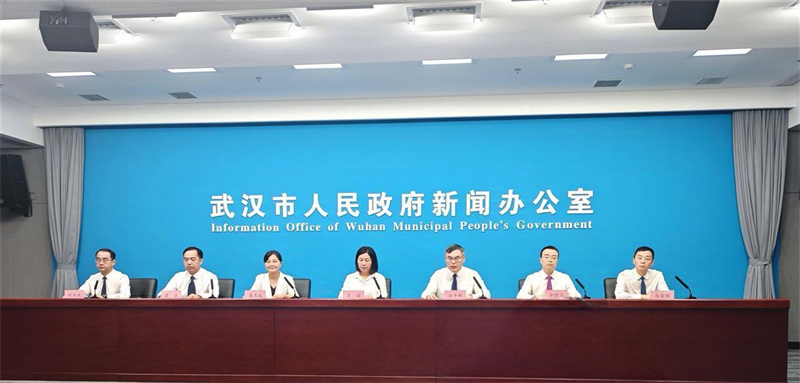
Press Conference Venue
On July 8, the Wuhan Municipal People’s Government Information Office released the “Three-Year Action Plan for Promoting High-Quality Development of the Yangtze River Midstream Shipping Center (2025–2027)” and provided updates on construction progress. In 2024, Wuhan Port handled a container throughput of 1.8763 million TEUs, accounting for 76.7% of Hubei Province’s total and 33.7% of the upper and middle reaches of the Yangtze River, solidifying its position as the “No. 1 Port in the Upper and Middle Yangtze.”
Currently, Wuhan Port operates 150 production berths, forming a coordinated container port cluster centered around Yangluo Port, with an annual container handling capacity exceeding 4 million TEUs and a throughput capacity of 150 million tons.
Wuhan has established the largest inland rail-water intermodal hub, opening over 50 routes. In 2024, rail-water intermodal transport volume reached 231,600 TEUs, a 44% year-on-year increase, ranking first among inland rivers nationwide in both total volume and growth rate.
The Yangtze New Area has been designated as the core zone for shipping center development. The port-adjacent area of Yangluo Port in the new district has attracted over 2,000 enterprises, 80% of which are industrial firms engaged in steel processing, equipment manufacturing, and health industries, forming a preliminary industrial scale. The area is focusing on developing three key sectors—port logistics, port-side manufacturing, and shipping services—to upgrade the port hub into an economic hub.
Tu Pinghui, a second-level inspector of Wuhan Yangtze New Area, stated that the district aims to achieve a target of 10 million TEUs, an international port, and a shipping hub by implementing a development strategy of “port + channels + network + platform + industry.” Efforts include expanding port-side industries, maintaining the direct shipping route between Indonesia’s Labota Port and Wuhan’s Yangluo Port, establishing a steel trade hub in Central China, building a cold chain supply network for imported meat, and developing steel processing, new materials, green building materials, shipbuilding, and repair.
Strengthening the bonded zone’s connectivity involves expanding imports and exports of nickel hydroxide, agricultural products, and vehicles; scaling up bulk commodity distribution; growing bonded processing to create an “raw materials-warehousing-processing-sales” industrial chain; and establishing cross-border e-commerce incub ators to foster industrial clusters.
Enhancing the multimodal transport network includes improving modern water-rail-road collection and distribution systems, advancing the “full transshipment upstream, full distribution downstream” model, and supporting the development of 10,000-ton river-sea direct vessels to build a global river-sea intermodal network.
The Wuhan Municipal Commerce Bureau highlighted significant improvements in customs clearance efficiency through innovative measures such as “joint boarding inspections” (reducing single-vessel inspection time to 3 hours), “direct loading and unloading” (speeding up processes by over 50%), and “inspection before loading” (cutting port waiting time by 35%). Huashan and Han nan port areas of Wuhan Port have received temporary opening status, expanding open zones to 3 port areas with 7 berths. Local customs clearance for “Chegu-made” vehicles has reduced export costs by 1,000 yuan per unit. In the first half of 2025, Wuhan Port recorded 84 international direct voyages, handling 132,000 tons of cargo—surpassing the total for all of 2024 and maintaining its leading position in the upper and middle Yangtze. (Text/Photo: Xixi)