Automated rigid sail system gets funding, with demonstrator due to be deployed in 2023, while charterers and dry bulk shipowners test systems in search of fuel and emissions savings
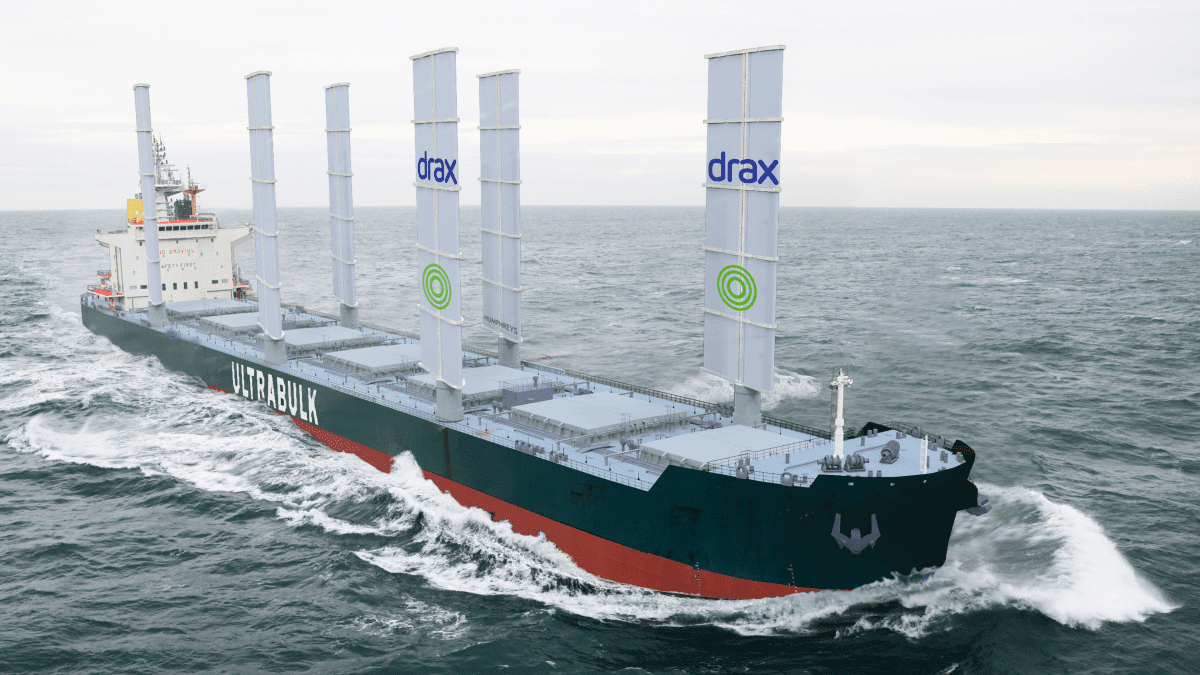
With backing from the Scottish Government and private investors, a broad collaboration of maritime stakeholders will develop and test a fully automated sail system, aimed at reducing CO2 emissions from commercial ships.
Funded to the tune of £5M (US$6M), the three-year R&D project brings together sail technology developer Smart Green Shipping (SGS) with fabrication specialist Malin, vessel charterer Drax Group, port group Peel Ports and class society Lloyd’s Register.
LR has issued an approval-in-principle to SGS for its FastRig wing sail technology system.
Before delivering a demonstrator for a commercial ship next year, the parties will install and test the FastRig wing sail technology at the Peel Ports Hunterston Port and Resource Centre on the banks of the Clyde by February 2023.
SGS says its technology could potentially be retrofit on 40,000 ships — mostly bulkers and tankers — delivering substantial fuel and greenhouse gas emissions (GHG) reductions. Modelling tests at the University of Southampton’s Wolfson Unit estimated the sails could deliver at least 20% fuel savings and GHG reductions for retrofits, and as much as 50% fuel savings for small- and medium-sized newbuild ships, according to SGS.
“When we look at the ocean, all we see are energy and the power of potential”
In combination with its sail technology, SGS has developed weather routing software, TradeWind, to optimise route planning to maximise wind energy potential, minimise fuel consumption and ensure just-in-time port arrival.
Clearly passionate about reducing emissions in the maritime sector, SGS founder Diane Gilpin noted during a live-stream press conference that to battle the climate crisis, the sector needs to move away from its reliance on fossil fuels. “When we look at [the] ocean, all we see are energy and the power of potential, the power of possibility.”
Additional WASP projects
SGS partner Drax Group is studying the deployment of other wind-assist ship propulsion systems on the vessels it charters. It has signed a memorandum of understanding with MOL Drybulk to study the feasibility of deploying a first- and second-generation environmentally friendly bulk carrier (EFBC) to carry Drax’s biomass.
The first EFBC will use MOL’s automated telescopic hard sail technology, known as Wind Challenger, and will evaluate the application of other technologies including rotor sails.
The second EFBC aims to at least halve emissions, with new vessel designs that use multiple Wind Challenger sails and low-carbon technologies still in development, and alternative fuels such as ammonia, LNG and synthetic fuels.
The first ship is expected to be on the water as soon as 2025.
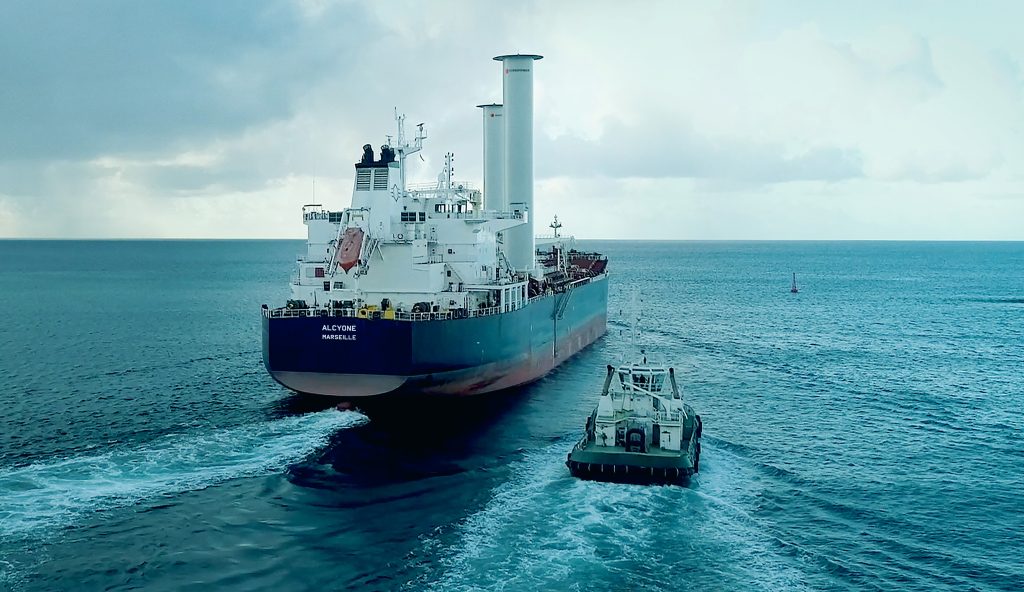
Elsewhere, dry bulk shipowner Berge Bulk has struck a deal with Anemoi Marine Technology to fit two of its dry bulk carriers with rotor sails. The first vessel to be retrofitted is the Valemax ore carrierBerge Neblina, which was made ’wind-ready’ earlier this year. Structural integration required prior to installing the technology was carried out during a scheduled drydock.
Berge Mulhacen, a 2017-built 210,000-dwt Newcastlemax bulk carrier, has been similarly prepared for the retrofit of four folding rotor sails.