Norway is spearheading the maritime industry’s drive to decarbonise with directives planning to introduce zero-emissions passenger ships and offshore support vessels in the next three years
Contracts are expected for low- and zero-emissions ferries and offshore support vessls (OSVs) by 2025 and rules pushing for green cruise ships in Norwegian fjords will be in force by 2026.
Norwegian Ministry of Climate and Environment, department for marine management and pollution control specialist director, Sveinung Oftedal set out government plans at Riviera Maritime Media’s annual Maritime Hybrid, Electric & Hydrogen Fuel Cells Conference in Bergen, Norway.
He updated delegates on the national action plan for green shipping, national policy frameworks and expectations for the coming years.
“Norway is committed to reducing carbon emissions by 50% by 2030 and to stimulate low-emissions solutions,” said Mr Oftedal.
There is a directive coming to tender for zero-emissions ferries in 2023. This will be followed in 2025 with contracts for low- or zero-emissions, high-speed passenger vessels. “This is in process,” he said.
Norway’s Government is looking into a directorate for the mandatory use of low-emissions OSVs in 2025 and zero-emissions OSVs by 2030. It is also considering introducing rules covering cruise ships entering Norway’s World Heritage Fjords from 2026.
The government is committed to raising the price of carbon taxes annually to Nkr2,000 (US$193) per tonne of CO2 equivalent by 2030.
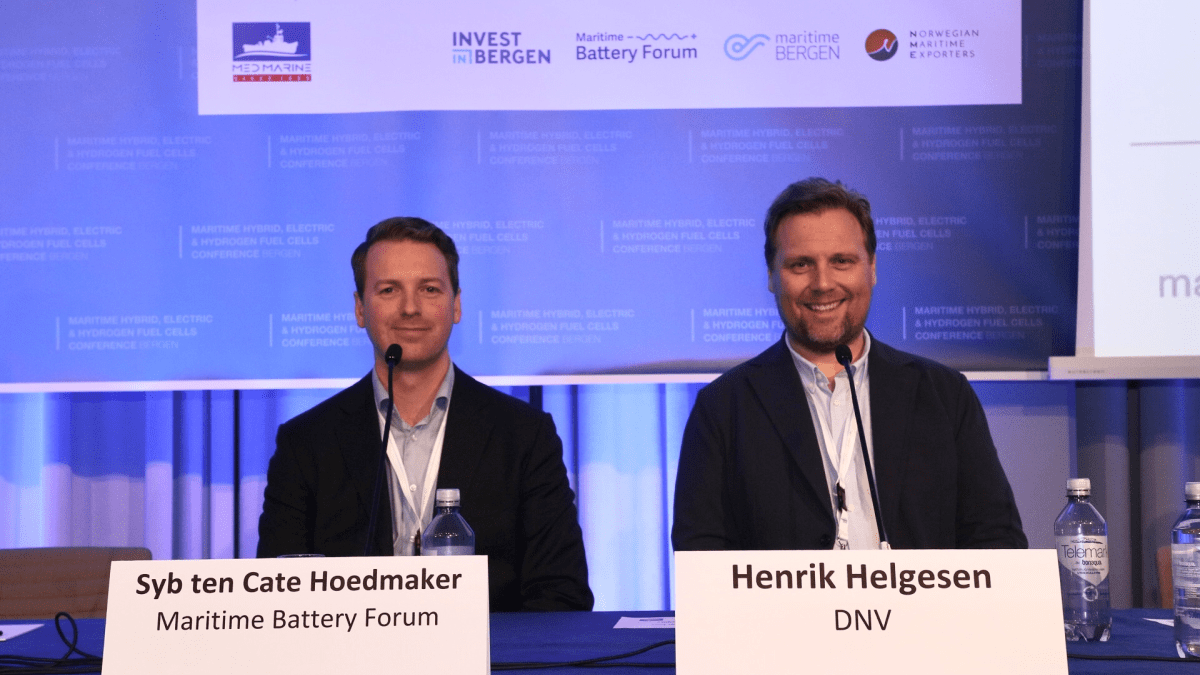
Also in the conference session, Maritime Battery Forum managing director Syb ten Cate Hoedemaker discussed the growing number of ships operating with energy storage systems and the increase in battery installations.
More than 150 vessels had batteries installed in 2022, up from 60 in 2021, which was a lull in installations, as there were more than 100 battery deployments in 2020 and 120 in 2019. However, prior to 2019, there were less than 40 installations per year.
“There are many different types of batteries and systems for different vessels,” said Mr Hoedemaker.
Batteries are now on passenger and offshore vessels, yachts, tugs, workboats, fishing vessels, research ships, patrol and naval vessels and shortsea and deepsea cargo ships. The average installed capacity per vessel is around 1.2 MWh in 2021 and 2022, compared with 800 kWh in 2017.
“This is expected to increase,” he added. “There is an increasing trend for plug-in hybrid and hybrid propulsion, and an increasing number of operating profiles for reducing fuel and emissions.”
The maritime industry still has many regulatory and classification challenges to overcome to enable more installations of energy storage systems. These include standardising and harmonising battery systems and ensuring their safety, as two accidents in 2019 and 2020 demonstrated more work is needed.
“All vessels can benefit from batteries,” said Mr Hoedemaker. “As battery sizes increase, our focus needs to be on safety.”
DNV senior consultant Henrik Helgesen summarised the latest work on both harmonisation and safety by classification societies. He highlighted how the International Association of Classification Societies’ safety and decarbonisation panel is developing instruments concerning batteries on ships.
“A possible outcome of this work would be unified requirements and recommendations for batteries on ships,” said Mr Helgesen. “This is the first step to harmonised regulations globally and it is very important this goes ahead.”
Another important step is by the European Maritime Safety Administration, which is developing guidance on battery safety to be adopted within the European Union.