Rixi: “Either it is removed in the next six months or it becomes like methadone”. Grimaldi: “Europe should have rewarded and relieved from fiscal burdens those who invest in new fuels and sustainable technologies”. The interventions of Romeo, D’Agostino, Gariglio and Merlo
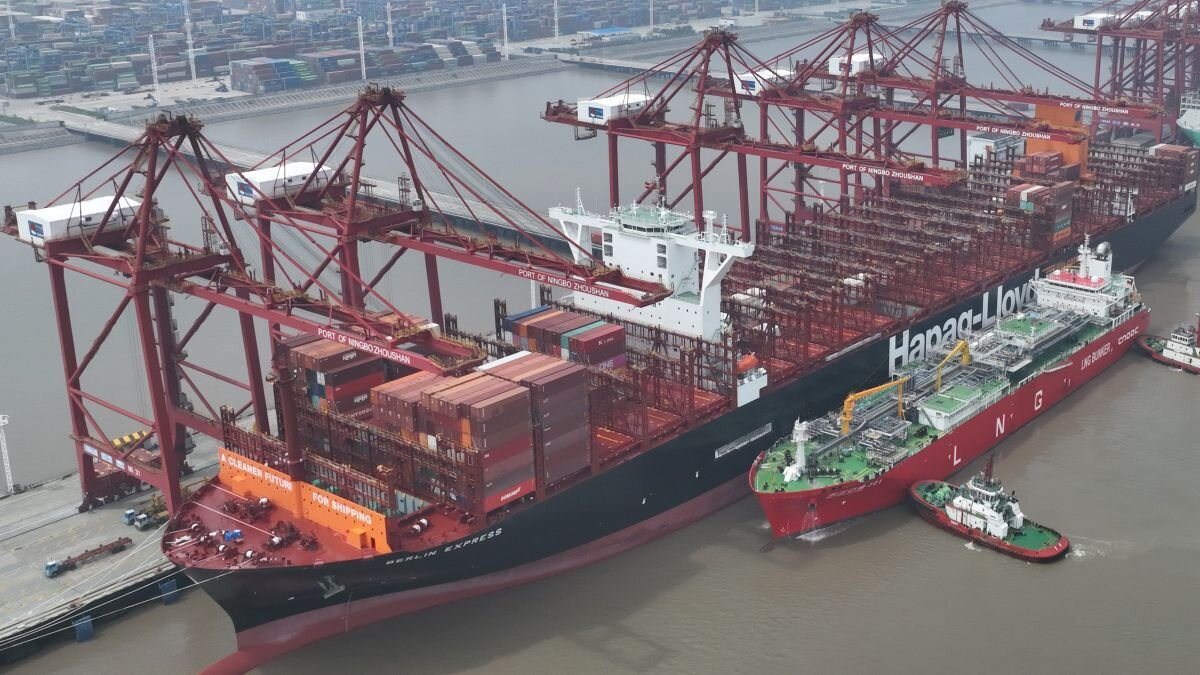
Rome – The issue of the ETS was central to the debate at the fifth edition of the Observatory on Ports by Shipmag titled “Geologistica, new routes for new markets”. The European emissions trading scheme applied to maritime transport finds everyone in agreement in declaring it a measure harmful to the economy, for Europe, that a fragmentary and non-global taxation compromises the competitiveness of European fleets and ports.
The Deputy Minister of Infrastructure and Transport, Edoardo Rixi, returning from London, from the IMO assembly, explains the battle Italy is fighting against the ETS, to prevent the ecological transition from turning into an obstacle to global trade. And he attacks: “The ETS must be removed in the next six months or it becomes like methadone”. Emanuele Grimaldi, CEO of the Grimaldi Group, adds: “What Europe should have done was reward and relieve from fiscal burdens those who invest in new fuels and in all new technologies”.
“Decarbonization is a right ambition we must have globally – says Grimaldi – and Europe, with all the countries that are part of it, could definitely be a protagonist that can push to find a global solution. I believe, instead, that these fragmentary solutions are useless. Furthermore, the ETS concerns 7% of global maritime emissions which are only 2% of total emissions, so it does not solve the problems of the earth, while it makes the European ports and shipping sector less competitive and also creates a terrible problem for the islands, despite territorial continuity”. It is also discordant that the ETS is applied to the maritime sector, he underlines, while “it does not exist for land transport, where it has been postponed to 2028. So I hope Europe can rethink it”. The ETS weighs on Grimaldi’s accounts for 200 million euros which in 2026, when the quota will rise to 100%, will become 300 million, if there is no stop.
The conference, opened by the publisher of Shipmag Franco Mariani and with greetings from Rear Admiral Francesco Cimmino, with the reports of Alessandro Panaro, head of maritime & energy at the SRM study center and of Roberto Ferrari, CEO of PSA Italy, with representatives of the embassies of Belgium, the Czech Republic, Iran and a Russian commercial representation present in the room, saw the interventions of Zeno D’Agostino, president of Technital, Davide Gariglio, president of the ADSP of the Northern Tyrrhenian Sea, Emanuele Grimaldi, Luigi Merlo, head of institutional relations for Italy of the MSC group, Vincenzo Romeo CEO of Nova Marine Carriers and vice president of Assarmatori, with Rixi closing the proceedings.
Romeo was also critical of the ETS. “Not only have supply chains lengthened, the market is changing, but we have increased the cost of logistics by increasing costs for shipowners who physically cannot sustain these new extra taxes and there has been an increase in freight rates due to the increase in costs which ultimately falls on the end user” he says.
But the crux is in this “we are not all playing by the same rules,” Romeo points out.
All of this within an international scenario dominated by uncertainty, with wars, tariffs, and political upheavals.
Gariglio underlines the importance of the US market for the port of Livorno, and the impact of US tariffs on Tuscan exports. “Obviously, companies will react and seek new markets – he says – and it will certainly be the shipping companies, in connection with the companies, who will open new markets and facilitate this opening.” “I believe, however – he adds – that an important role falls to the public sector, it must be done by the government and the port system authorities. But as an Adsp we are a small thing in the world and the intervention of the country system is necessary.”
For Zeno D’Agostino, who recently moved from the role of port manager to that of port builder, “we have entered a new era of overall instability.” And this is also why the fervor in building new infrastructure in all countries makes sense. “Everyone carves out the possibility of being part of an overall corridor with a redundancy of infrastructure necessary to allow goods to move in times of crisis.”
“Trump has placed maritime policies at the center of his political action in a nation that has never had a maritime policy – argues Luigi Merlo – he realized that to govern the world he must deal with it. So if before we had a China that was very attentive, dynamic, and aggressive on maritime policies, now we also have the United States: not only tariffs, but also the Panama Canal, attempts to change the name of the Gulf of Mexico. So we have two blocs clashing and paradoxically Europe, which has a competitive advantage (five of the six major shipping companies in the world are in Europe) instead of protecting this asset, penalizes it with the ETS.”