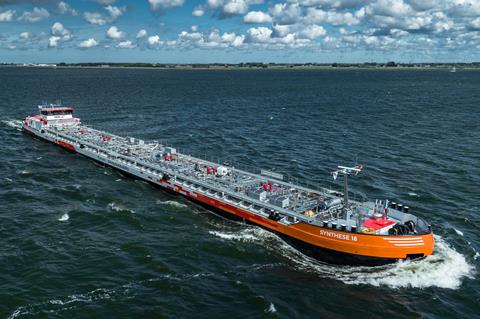
Encapsulating the innovative spirit behind new developments in the European inland shipping fleet, the diesel-electric Type C tanker Synthese 18 was formally named in Rotterdam last week.
Purpose-designed to transport chemical products on the River Rhine and its tributaries, the 110m newbuild incorporates the Veth L-Drive electric propulsion system in combination with a high-capacity form optimised for shallow-water operations.
“The new order in chemical shipping on the Rhine system.” “/ /
Source: HGK Shipping
The new order in chemical shipping on the Rhine system.
While the vessel offers a maximum payload of 2,700t, the design provides for navigation in the most restrictive conditions, enabling a 300t load to be carried in a channel depth of just 1.05m.
The chemical tanker was ordered in March 2021 by the German company HGK Shipping from the Dutch shipyard De Gerlien van Tiem at Druten. Hull construction was assigned to Santierul Naval Orsova in Romania, with outfitting and completion fulfilled at the Dutch main contractor’s premises on the River Waal.
HGK Shipping director Norbert Meixner said “The Synthese 18 marks a real milestone in transporting liquid chemicals on European waterways. It will enable us to maintain our role as a reliable partner for industry even during periods when water levels are low.” This feature of the new vessel is salient to the inland shipping sector’s experiences over the recent past, when prolonged dry periods have led to Rhine depths becoming critically low.
The barge’s shallow draught has been made possible by the optimised uplift characteristics of the hull, through the arrangement and specific nature of components such as the loading system and drive technology.
The inland tanker was conceived in-house, at the Cologne-based owner’s design centre, and developed in cooperation with the Dutch firm Wijgula, which has been entrusted with the vessel’s freight management.
The shape of both bow and stern are unconventional in an inland vessel context, notably as regards the adoption of a bulbous bow. The propulsion system consists of three Veth L-drive rudder propellers and electric motors installed directly on the respective shafts, and delivering 405kW apiece. Electrical energy is supplied by four gensets powered by Euro Stage V-compliant Scania DC13 diesels each rated at 340kW.
The overall engineering and propulsion system promotes operational flexibility and efficiency, the latter being enhanced through a power management system.
The combination of draught optimisation and alternative drive system was previously applied by the company to the 110m inland liquefied gas tanker Gas 94, commissioned in 2021. During February this year, a sister newbuild was ordered from Dutch shipbuilder TeamCo Shipyard at Heusden, and a third such gas tanker is expected to be contracted in the coming months.
Moreover, four further examples of the Gas 94 series are in the planning stage, while another two Type C chemical carriers, as hydrogen-ready versions of the Synthese 18, are under construction.
HGK’s tanker fleet transports about 6m tonnes annually on the Rhine and adjoining rivers and the north-west German canal network, as well as in Belgium, France and the Netherlands.