Groningen Maritime Board (GMB) has initiated a study into the possibility of establishing a centre for robotised shipbuilding production in the northern Netherlands.
A grant of EUR250,000 (US$263,000) has been provided by Groningen Province to GMB for a feasibility study into a facility that would be used on a shared basis by the industry in the region. The Shared Facility project will focus on the technical, operational and economic viability of establishing a dedicated plant for robotic production of micro panels to be supplied to participant shipyards.
The overarching aim is to better safeguard the industry’s future in the face of intensified global competition by raising the technological level, improving efficiency and optimising cooperation throughout the shipbuilding chain.
The project has been implemented by the GMB Foundation in conjunction with ship designer Conoship International, Rotterdam consultancy Marstrat, and Dutch technology company association FME, in collaboration with a number of shipbuilders and suppliers from the Netherlands’ northernmost provinces. The Shared Facility research team’s findings and decision are due this year.
Although the region’s maritime cluster remains one of the most dynamic and extensive in Europe, with a gravitation to the smaller classes of trading ship and special-purpose vessels, orders are being lost to low-wage economies such as China for whom shipbuilding is of industrial strategic importance.
Automation and robotisation are viewed by the Shared Facility advocates as a potentially decisive means of raising efficiency, boosting output with the same number of employees, increasing quality and shortening contract to delivery times. An additional prospective benefit of such investments is fostering greater attractiveness to the younger generation, against a backcloth of the increasing average age of workers in Dutch shipyards and allied sectors, and persisting difficulties in recruiting personnel.
However, as the business of many of the northern Dutch firms often entails customer-specific solutions and small series per product, there are challenges attached to the introduction of robotised section building, as this requires an integrated, comprehensive approach. Conoship said “This demands a cultural shift across the entire design phase. Rather than thinking in terms of processes specific to one company, we should approach the design from the perspective of the entire shipbuilding chain. This will help the full shipbuilding chain to achieve significant savings throughout the process. A degree of standardisation is paramount.”
Also central to the robotisation theme is the better use of data. Application of the digital twin concept would provide a model from which production data can be generated to control cutting machines and automated systems such as welding robots and collaborative robots (cobots), for the manufacture of micro panels. A subsequent step would be to build a self-learning production process through the application of artificial intelligence (AI) techniques.
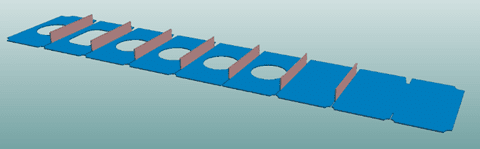
The project anticipates manufacturing micropanels at a central robotised ‘Shared Facility’.
The provincial government of Groningen brought the Groningen Maritime Board into being during 2019, as one of several measures in support of the northern shipbuilding cluster. Marstrat had carried out a market study on the sector the year before, and calculated that the cluster generated Euro 1.3bn in annual revenues and sustained 4,300 jobs. Two decades earlier, the employment figure had been around 7,000.
The region has a track record in joint initiatives and cooperation, leading examples of which are Conoship itself and the shipbuilding kit provider Centraalstaal of Groningen.