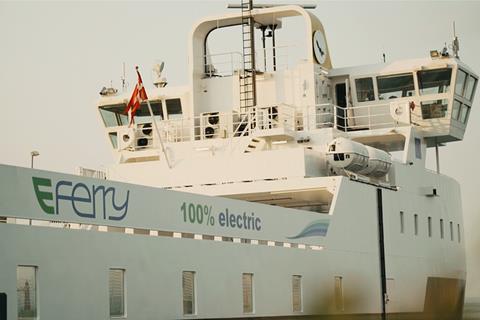
The electric ferry Ellen sailed 50 nautical miles (92 kilometres) on a single battery charge during the International Energy Agency’s 7th Annual Conference on Energy Efficiency. The distance marks a new world record.
The islands of Ærø and Als in Southern Denmark are connected by Ellen, the longest ranging fully electric ferry in the world. Ellen set the new world record on 9 June. On her normal, daily trips, the ferry sails 22 nautical miles, or 40 kilometers, from harbor to harbor before recharging.
Ellen does not emit carbon and operates at 24% lower cost than a new diesel ferry. She started sailing in 2019.
“The electric ferry Ellen set a new record when she sailed 50 nautical miles (92 kilometres) on a single battery charge” “/ /
Source: Danfoss
The electric ferry Ellen set a new record when she sailed 50 nautical miles (92 kilometres) on a single battery charge
The ferry was designed by Jens Kristensen Consulting Naval Architects and built by Søby Værft. She is just under 60m long, has a breadth of approximately 13m and sails at speeds between 13-15.5 knots. She is capable of carrying 198 passengers in summer months, with this capacity dropping to 147 during the winter. The ferry can also carry 31 cars or five trucks on its open deck. As well as having a capacity of 4.3MWh, it is also the first electric ferry to have no emergency back-up generator on board.
Danfoss Editron has supplied the full-electric drivetrain, includingelectric Editron drivetrains and propulsion motors for the ferry. The company’s EDITRON system comprises two 750kW propulsion motors and two 250kW thruster motors, both of which run off synchronous reluctance assisted permanent magnet technology and are controlled by DC/AC inverters.
As well as the electric drivetrain, Danfoss Editron also provided the vessel’s power management system for the complete onboard automated power and load control. Additionally, the company delivered the onshore charging station and charging arm.
One of Ellen’s key benefits is the efficiency of her propulsion system which reaches 85% grid-to-propeller. This is over twice as efficient as a conventional diesel-powered ferry (tank-to-propeller) and enabled a 20% reduction in travel time compared to the diesel-powered ferry she replaced.