New resupply and research vessel is built with first-of-a-kind, full-spade rudder system to meet the challenging operating conditions and manoeuvrability requirements of the Southern Ocean
Operating in some of the fiercest ocean conditions in the world, Australia’s Nuyina serves as a critical resupply lifeline to Australia’s Antarctic scientific bases, while advancing the country’s Southern Ocean research ambitions. Transiting thousands of kilometres of the world’s stormiest seas and navigating Antarctica’s formidable sea ice barrier required the vessel’s unique rudder and steering gear system to be engineered and fabricated to exceptionally high standards.
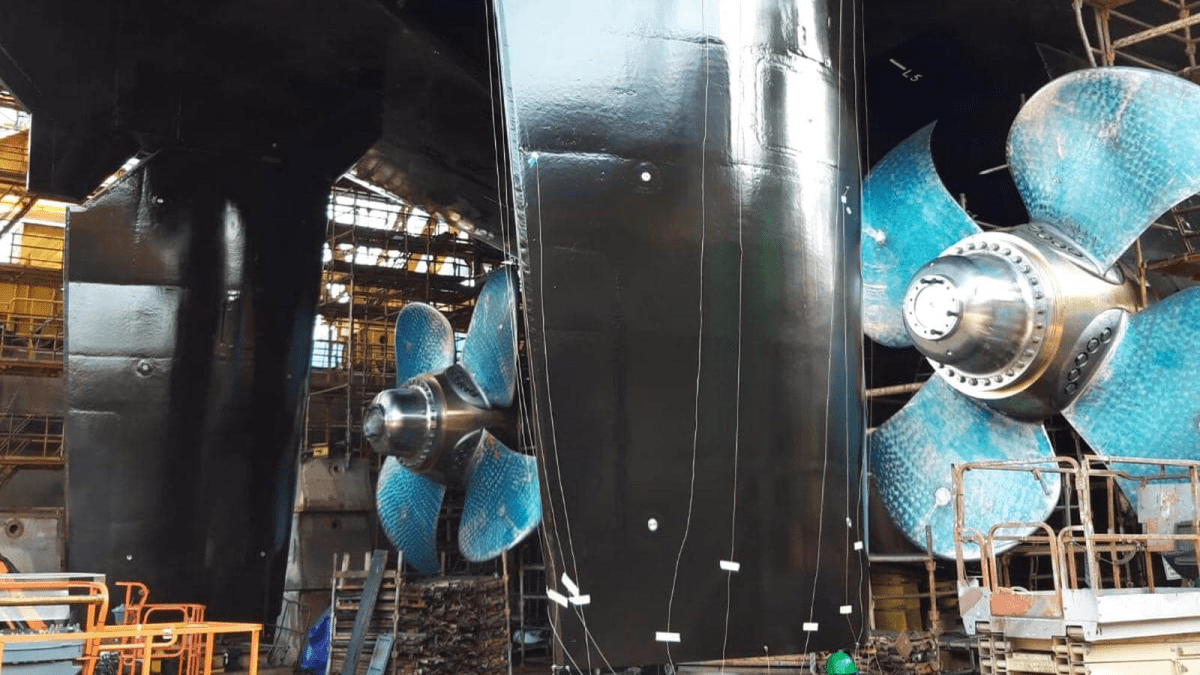
The free-hanging, full spade rudders for Nuyina — something previously unheard of in an icebreaking vessel — were supplied by Damen Marine Components (DMC). DMC manufactured the Atlantic model full rudder spades under its Van der Velden Marine Systems brand.
DMC regional sales director Bogdan Mocanu detailed the complex engineering and fabrication challenges required for the rudders during Riviera Maritime Media’s Heavy-duty steering system for course-keeping in Antarctic waters webinar, presented as part of Marine Propulsion Webinar Week. The event was sponsored by Damen Marine Components and held in mid-May.
“The difficulty resided … in the extreme ice loads on the one hand and in addition, in the Polar class rules not covering every part of rudder design,” said Mr Mocanu. “That is why a special class certificate and provision of special arrangements were necessary.” This required DMC to work closely with class society Lloyd’s Register throughout the process.
“The rudders are by far the heaviest per square metre that DMC has ever built”
From concept design to model testing to final installation, “the head boxes on the rudder got larger and larger in order for the vessel to undertake its aft icebreaking mode,” he said.
Those special arrangements under class in Polar conditions require rudder stoppers to be installed to protect the steering gear against damage. “Our solution was to place the stoppers on top of the gudgeon. The stoppers are part of the gudgeon forging,” he explained.
Weighing 17 tonnes, the 2-m-high gudgeon is the centre part of the rudder blade. The thickness of the gudgeon led to a very wide rudder blade profile.
To design the rudder stock to meet the requirements of the extreme Polar loads, structure analysis was performed. “The difficulty with the stock was not in its design,” said Mr Mocanau. “The challenge, in fact, came in obtaining the material properties.” As a result, the initial forging suppliers selected had difficulty in producing the large diameter stock, scrapping four 35-tonne forgings due to inner cracks revealed in ultra-sonic testing. Mr Mocanu, said, however, another supplier was able to produce the necessary forgings.
Meanwhile, working to DMC’s specifications, MacGregor Hatlapa manufactured and supplied the Poseidon series steering gear assemblies and the hydraulic systems.
Challenging design
Indeed, the entire Polar Class 3 icebreaking resupply and research vessel presented Knud E. Hansen with one of its “most interesting and challenging designs,” said a company executive. Joining Mr Mocanu in the webinar, Ken Goh, Knud E. Hansen general manager Australia, said the naval architectural firm had to consider 1,200 design points in creating the vessel to satisfy the demanding requirements outlined by the Australian Government.
He told webinar delegates that Nuyina faces some of the highest sea states anywhere in the world on its route. “Very challenging for steering systems,” he observed.
Mr Mocanu’s presentation was somewhat of a revelation for Mr Goh, who admitted it was the first time he had seen the engineering that goes into the rudder system of Nuyina. “It’s actually very impressive,” he said.
“The difficulty resided in the extreme ice loads and in the Polar class rules not covering every part of rudder design”
During a Q&A period, Mr Goh explained Knud E. Hansen had chosen a full spade design for Nuyina because of “the manoeuvring power that you could get with a larger size area.” He asked Mr Mocanu if this was the most challenging rudder system that DMC had to design in terms of strength and size?
“Yes, indeed,” responded Mr Mocanu. In fact, the rudders are by far the heaviest per square metre that DMC has ever built; the rudder stocks have a diameter of over a 1,000 mm. This, together with the materials used, made them very challenging to manufacture and install.
Impressive features
Nuyina’s heavy-duty steering and rudders are not the only features that are impressive about the vessel. A multipurpose cargo and research vessel rolled into one, it resupplies five different Antarctic scientific and research bases, using its “various toys” – landing craft, amphibious vessels and helicopters –
explained Mr Goh.
Built by Damen Shipyards Galati in Romania and delivered in October 2021, the icebreaking vessel has an overall length of 160.3 m, beam of 25.6 m, and maximum draught of 9.3 m, with the capacity to carry 1,671 tonnes of cargo fuel, 1,200 tonnes of cargo and 96-teu of containers. It can accommodate 117 passengers and 32 crew, has an endurance of 90 days and range in excess of 16,000 nautical miles. Additionally, it has the ability to break 1.65 m 700kPa ice and 300 mm of snow at 3 knots and is dynamic positioning class-2 capable in sea state 4, Beaufort 8.
To carry out its scientific mission, the Australian Antarctic Division required Nuyina to be designed to meet DNV’s SILENT-R notation for acoustic performance. This requires the whole vessel, the propulsion system specifically, to have very low self-emitted noise levels. However, the vessel also needed to be powerful, with 26 MW of shaft power.
“The high level of power required as well as low noise requirements meant that pods or thrusters could not be used,” said Mr Goh. Particularly, the type of bearings and gear transmission systems in those propulsion systems would not be able to meet the SILENT-R notation requirements. Additionally, there was some concern that the pods were not proven in Antarctic waters. It was felt that shafts were the more reliable solution, he said. As a result, the naval architectural firm chose a twin-shaft propulsion system.
In the end, Mr Goh explained, the best solution was thought to be a hybrid solution, which combined the benefits of a diesel mechanical system with a silent electric propulsion system. The silent electric propulsion system could be engaged independently from the diesel mechanical system for silent operations.
Earlier this year, Nuyina completed its first Antarctic mission. During the 39-day, 13,000-km voyage to Davis and Casey research stations, it successfully supported helicopter operations, delivered fuel and performed scientific research.