The owner consortium Aspo is divesting from many operations by selling, among others, the Bakers’ business and has otherwise shifted to a portfolio strategy. Last year, the company already announced that its operations are intended to be divided into separate companies, which best supports value creation for the owners. However, in last week’s investor info, Aspo’s management also announced plans to sell ESL Shipping, which raises many new questions in the current geopolitical situation.
Our largest domestically owned cargo shipping company was born in the summer of 1949, when the Helsinki-based Fuel Cooperative acquired its first vessel, the S/S Arkadia, to bring coal from Poland to Finland. In October 1950, the company established a separate shipping company, Etelä-Suomen Laiva Oy, to which the Arkadia was transferred, and a little later the new company took over from the ceasing John Nurminen the vessels named Alppila and Eira. Prior to this, the vessel named Kaisaniemi, a German ship that had previously operated in the Baltic Sea, had already been purchased from the United States.
In October, Etelä-Suomen Laiva Oy celebrated its 75-year journey and has published a new history of the shipping company, which is for sale in our maritime museums in Kotka and Turku. It was written by the shipping company’s own communications officer, Olli Tuominen. Information about the shipping company’s history has also been published earlier in the history of the Aspo group written by Jukka Hakala from 2009.
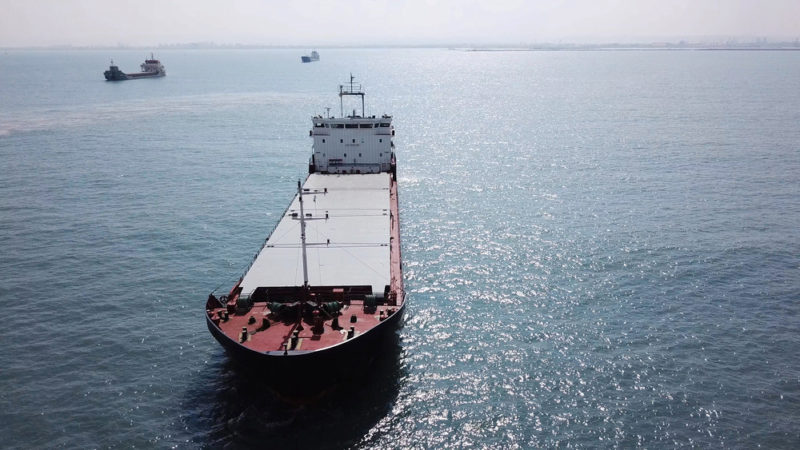
Today, ESL Shipping is a significant bulk shipping company that owns and operates, under the Finnish flag, six IA Super ice class, crane-equipped handy-size cargo vessels, the oldest being Pasila and Tali, built in the 1990s in Rauma, Finland. Eira is from 2001 and Alppila is from 2011. MS Haaga and Viikki were completed in 2018 and were at the time the world’s first LNG-powered bulk carriers. In addition, the company has four 14,000 tdw 1A Super ice class deck barges and for them two 7.6 MW push tugs. MS Kallio has just been sold to the operations of the Norwegian Kjell Inge Røkke. Aker QRILL Company, the global leader in krill harvesting and production of krill-based ingredients, has simultaneously announced the conversion work for the vessel. Its new name will be Antarctic Enabler. Through reconstruction, the vessel will be converted into a modern floating storage equipped with technologies that enable support platform operations for unmanned drones, which in turn help map krill concentrations and optimize fishing efficiency. Furthermore, the vessel offers cargo capacity for nearly 10,000 tons of krill meal and significant bunker capacity for refueling fishing vessels during fishing operations, which eliminates operational downtime and maximizes efficiency. The completely rebuilt and operational combination as a floating storage and drone platform represents an investment of approximately 26.5 million US dollars according to the buyer.
New handy-size vessels on order
ESL Shipping is currently building a series of four new, fossil-free, 1A ice class handy-size vessels. The investment for the four vessels ordered from China is 186 million euros, and ESL Shipping has options to expand the order with several vessels. The 18 million euro sales price from the sale of Kallio helps ensure the realization of the investment. Previously, the company already sold its Supramax vessels Arkadia and Kumpula for 37 million dollars. Related to the newbuildings, OP Suomi Infra Ky, together with Mutual Pension Insurance Company Varma, invested a total of 45 million euros in ESL Shipping at the beginning of 2024, corresponding to a 21.43% ownership share in the shipping company.
In the same context, the company’s own experts left the shipping company’s board and were replaced by Aspo Group executives and OP Bank’s Ossi Vasala. The original shareholding was valued in the transaction at 165 million euros and the company as a whole at approximately 300 million euros.
The competitiveness of the next-generation vessels ordered from China is based on customer interest in fossil-free cargo solutions over time, leading energy efficiency in the market, flexible cargo space design, and lower operating costs. The new vessels can be operated completely fossil-free by using green hydrogen-based e-methanol or bio-methanol. Battery packages ensure emission-free port operations.
“Our strategy is based on sustainability leadership and our unique ability to develop and provide reliable infrastructure for the green transition industry in the ice-bound Nordic region. We have developed these highly flexible multi-fuel vessels in close cooperation with our industrial partners,” said ESL Shipping’s Managing Director Mikki Koskinen on the occasion of the order.
The vessels will be built in Nanjing, China, by China Merchants Jinling Shipyard (Nanjing) Co, Ltd, and will be taken into service between the third quarter of 2027 and the first quarter of 2028. They will replace the shipping company’s older handy-size fleet sailing under the Finnish flag.
In connection with the vessel order, possibilities for using different vessel ownership and financing solutions to accelerate business growth and expand the service are being explored. This may include, among other things, pooling financing as a financial instrument, which ESL Shipping has already successfully used in financing the hybridicoaster series. The measures and timing will be made in accordance with Aspo’s portfolio strategy and financial targets.
Investments in the Swedish subsidiary’s Green Coasters
A few years ago, ESL Shipping purchased the shipping company AtoB@C from Ystad, Sweden, whose business was based on a fleet of smaller 3,000 – 6,000 tdw coaster vessels. Together with its Swedish subsidiary, ESL Shipping had a total of 38 vessels at the end of September, with a total capacity of 320,000 tdw. Of these, 25 were fully owned (78% of tonnage), two were minority-owned (3%), and the remaining 11 vessels (19%) were on time charter. The figures include the Green Coaster pool, which currently consists of seven vessels, four of which are owned by ESL Shipping and three by investors.
ESL Shipping is currently building a series of six highly energy-efficient 1A ice class electric hybrid vessels. The total value of the investment is approximately 70 million euros, and its cash flows are spread mainly over the years 2021–2026. The new vessels are being built at the Chowgule and Company Private Limited shipyard in Goa, India.
In 2022, ESL Shipping established the so-called Green Coaster pool. As a result, in addition to its own vessels, six Green Coaster vessels were ordered from the shipyard, which are then sold to a company owned by the Green Coaster pool investors. Every other vessel from the 12 vessels to be built at the shipyard is built for ESL Shipping itself, and the others, in turn, are sold to a company owned by the pool’s investors upon their arrival in Europe. The vessels’ sales price is based on their total costs.
All twelve built and under construction Green Coasters are operated and will be operated in the ESL Shipping Green Coaster pool, as the vessels are delivered.
ESL Shipping charters the vessels owned by pool investors. The charter is calculated based on the pool’s revenues and is fully variable. Since the charter is variable, in accordance with IFRS 16 standards, no lease liability or right-of-use asset is recognized; instead, lease payments are recorded as lease expenses.
The series’ last vessel is already well underway in its construction in India. The eighth vessel is expected to enter commercial service in the Baltic Sea still this year. Deliveries occur quarterly. The last vessel is expected to be completed in the autumn of 2026. One of the newbuilds has already been sold to a pool investor company. The next Green Coaster vessel is expected to be ready for sale before the end of the year.
The investment in a series of four new, fossil-free Handy-size vessels will take place between 2024 and 2028. These vessels, to be built in China, are scheduled to enter service in the third quarter of 2027 and the first half of 2028. ESL Shipping has already paid 29.0 million euros in advance installments to the shipyard in China, calculated at a hedged rate.
The shipping company’s remaining Green Coaster investment commitment was 16 million euros in September. This amount includes only the future payments for the shipping company’s own Green Coasters. The remaining investment commitment for the larger Green Handy vessels was correspondingly about 158 million euros. This amount includes the remaining payments for all four Green Handy vessels, as an agreement for the resale of one Handy vessel has not yet been made. The investment’s cash flows are expected to be approximately 10% in 2026, 60% in 2027, and 30% in 2028.
Last year, ESL Shipping’s revenue was 206.2 million euros and comparable EBITA was 16.9 million euros. The target set by the parent company for 2028 is over 300 million euros in revenue and a comparable EBITA of 14% for the shipping company. When investors bought the shipping company’s shares last year, the company’s valuation was calculated at 300 million euros.
Aspo transitioned to a portfolio strategy
Aspo had significant business operations in Russia, which were, however, divested immediately following Russia’s invasion in 2022. The group decided to actively start seeking new business opportunities from the West to ensure growth.
Last year, Aspo announced it was transitioning to a portfolio strategy. In the recent Q3 stock exchange release of this year, CEO Rolf Jansson stated that the group remains committed to its long-term financial ambition and vision to create two separate companies from Aspo: Aspo Infra and Aspo Compounder. This is an essential part of Aspo’s goal to create value for its shareholders. The shipping company was intended to form the main part of the new infra portfolio.
However, in connection with the Q3 earnings call, CEO Jansson emphasized the group’s goals to support Telko’s organic growth, while the group board’s guidance regarding ESL Shipping has now been amended to include the potential sale of the entire shipping company by the end of 2026.
Aspo estimates the operating environment will remain challenging. It expects ongoing geopolitical uncertainty and global trade tensions to negatively impact economic growth and international trade. However, increased defense and infrastructure spending in Europe may support economic recovery.
Aspo expects the full-year improvement in earnings to come mainly from the results of the Green Coaster vessels, the acquisitions of Telko and Leipuri completed in 2024, and various enhanced earnings improvement measures in Aspo’s businesses. Aspo expects demand for ESL Shipping’s services to remain weak. It expects the shipping company’s contract volumes to be fairly low and spot market prices to be low. Seasonally, however, volumes are expected to improve towards the end of the year.
As we have previously reported, Jansson stated that Aspo will focus on improving profitability in 2025.
“The ongoing profitability improvement programs in all our businesses are producing clear results. In addition, we are benefiting from the acquisitions made by Telko and Leipuri and the investments by ESL Shipping, which are gradually being reflected in the company’s profitability. ESL Shipping’s profitability, especially in the Coaster vessel segment, has been weakened by spot markets that have remained weak and weaker-than-expected demand from the forest industry. The profitability of the new generation Handy and Coaster vessels remained strong, and they are expected to support ESL Shipping’s future profitability development. The number of dry-docking days – 289 days (114 last year) by the end of September – was high due to planned maintenance work and an engine fire on the M/S Tali in August, which also weakened profitability. The vessel was out of service for two months. Coaster segment vessel capacity was reduced by returning two loss-making time-chartered Coaster vessels to their owners.
“The aim for this year is to improve profitability and thereafter to carry out the sale of ESL Shipping or a partial demerger of Aspo by the end of 2026, taking market conditions into account. The essential thing is to find the best solution for ESL Shipping and Telko in terms of value creation and business development. Both companies have ambitious growth plans. With the change, we want to maximize shareholder value,” says Rolf Jansson.
Aspo Group’s revenue in January-September grew and was 349.8 Meur from continuing operations (335.0 Meur in the previous year). Comparable EBITA for the entire Group grew and was 27.5 Meur (21.1 Meur), or 6.0% (4.9%) of revenue. Of this, ESL Shipping’s share was 12.7 Meur (12.6 Meur) and Telko’s was 13.5 Meur (8.7 Meur).
The total revenue for ESL Shipping in 2024 was 206.2 Meur and EBITA was 16.9 Meur. Of the revenue, 79.1 Meur came from the handy-size sector and 94.2 Meur from coasters.
The effects of a potential sale of the shipping company
Recently, there has been a lot of talk and discussion about the security of supply of our maritime traffic. Many of our shipping companies are already under foreign ownership; Finnlines is owned by the Grimaldi family, Borea and Transfennica by the Dutch Spliethoff, Silja Line by the Estonian Tallink and the Spanish tug company Boluda has begun conquering the services of Baltic Sea ports, as has Stena Line, which is just taking over the operations of Wasa Line. ESL Shipping, on the other hand, has been considered a strong national operator.
In the tanker sector, the Finnish Transport and Communications Agency (Traficom) and the pension insurance company Ilmarinen, during the occupation of Ukraine in 2014, ended up jointly owning our critical tankers and terminal tugs to secure the fuel supply. OP Bank’s funds and the pension insurance company Varma are already owners of ESL Shipping with a 21.4 percent share.
Pension insurance companies have now received permission for greater risk-taking, which in principle could enable keeping the shipping company ownership in Finland. If Aspo were to end up relinquishing the shipping company abroad, a fierce political debate is certainly to be expected.
Text Mikko Niini