Maersk gets permission to move three of its routes to its own terminal in New Jersey. A judge has ruled that the shipping line can terminate an agreement with a competing terminal prematurely. The counterpart is expected to keep fighting the decision.
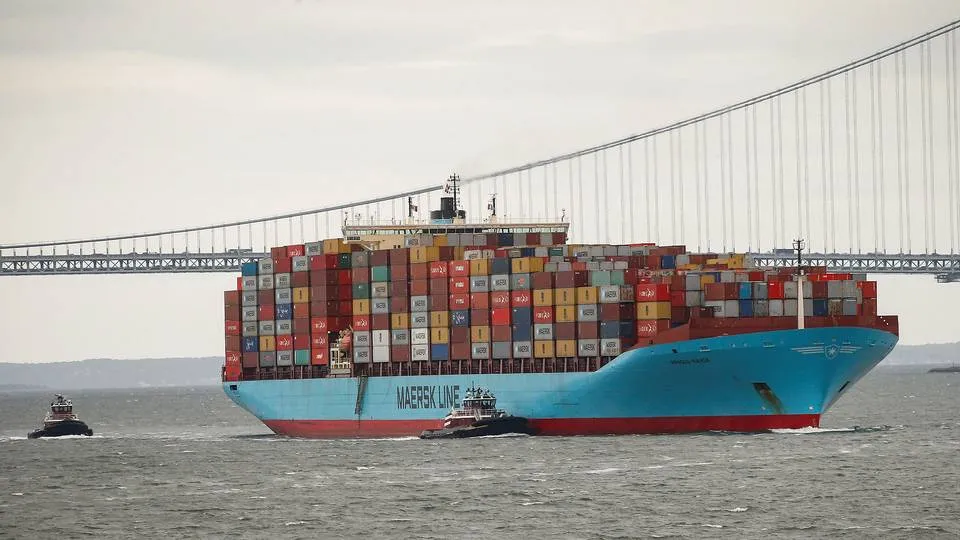
The dispuute concerns three of Maersk’s fixed services to New York, which will now be moved to APM Terminals’ port in New Jersey. | Photo: Brendan /Ritzau Scanpix
Maersk is free to tear up an exclusive port agreement and move to its own terminal in New Jersey after a judge dismissed a temporary restraining order on Friday.
As WPO reported last week, Maersk terminated a contract with port operator Global Container Terminals, GCT, in New York in early April.
The shipping line will instead move to its own terminal on the other side of the Hudson River in neighboring state New Jersey.
Last week, GCT asked a court to block the termination of the lucrative contract. The terminal operator says that the contract can at the earliest be terminated at the end of 2021.
We announced the planned move to achieve better operational efficiency in APM Terminals Elizabeth”
Maersk
Maersk has maintained that it can rightfully leave the partnership. And on Friday, a court in New York gave Maersk de facto permission to terminate the agreement from May 1 by dimissing the restraining order filed by GCT.
The shipping line now looks forward to using the terminal in New Jersey, which is operated by Maersk’s own port unit APM Terminals.
“We announced the planned move to achieve better operational efficiency in APM Terminals Elizabeth after its recent USD 200 million upgrade and expansion,” writes Maersk.
Fears shutdown
The ruling is a bitter setback to GCT, which has warned of serious consequences if Maersk is allowed to rip up the contract.
A premature termination would send the operating result for the year into the red with a deficit of USD 7.1 million, thus creating doubt about the company’s future, says GCT. The port company also fears that it could lose more than 100 jobs.
GCT expects to lose around 240 port calls at its terminal on Staten Island, New York, following the termination.
However, Maersk says that GCT is exaggerating the consequences. The shipping line notes that the company has four terminals in the US and is backed by financially strong owners in the form of IFM Global Infrastructure Fund and British Columbia Investment Management.
We fully intend to enforce all legal rights and remedies to protect our business”
GCT in a response issued prior to Friday’s court ruling
Maersk also pays around USD 5 million to leave the agreement, which the container line considers a generous compensation considering the uncertainty around container shipping created by the coronavirus.
WPO is trying to get a comment from GCT.
However, the port company has previously said that it is willing to go far to block Maersk’s termination, and as such, it is far from certain that Friday’s court ruling marks the last word in the dispute.
“We fully intend to enforce all legal rights and remedies to protect our business and the integrity of the contractual commitments by our customers,” said the company in a response to WPO that was sent prior to Friday’s ruling.
Close partnership with APM Terminals
The deal between Maersk and GCT has been in place since 2015 and has been extended several times. It was most recently extended in 2018.
It applies to the three services NAE, ECSA and ESCA. The services are also used by Maersk’s German subsidiary Hamburg Süd and German competitor Hapag-Lloyd, with whom it shares capacity on a few stretches.
Maersk has previously made a big deal of keeping its shipping line and port operator APM Terminals separate in order to ensure that other shipping companies would not worry that Maersk’s ships received special treatment in the terminals.
In 2016, though, the group decided that Maersk and APM Terminals would, going forward, move close to together to help each other.
This happened as part of the former conglomerate’s strategy to become a pure play transport group.
English Edit: Daniel Logan Berg-Munch