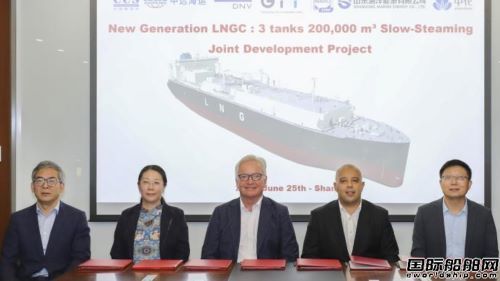
Recently, French engineering company GTT announced a joint development project with Chinese enterprises to design a new generation of LNG carriers.
The collaborating companies include Sinochem Petroleum Shipping (Singapore) Pte Ltd (charterer), Shanghai COSCO Shipping LNG Investment Co., Ltd. and Shandong Marine Energy (Singapore) Pte Ltd (shipowners), COSCO Shipping Heavy Industry Co., Ltd. (shipyard), Marine Design & Research Institute of China (ship design institute), as well as China Classification Society and DNV (classification societies).
As part of the project, GTT will provide expertise in the development of cryogenic cargo tanks and pipeline handling systems. The charterer, shipowners, shipyard, and ship design institute will each contribute within their respective fields to ensure the vessel design fully meets future market demands. Ultimately, the overall design will undergo independent review by DNV and China Classification Society.
The project aims to obtain “Approval in Principle” (AiP) from both classification societies by the end of this year. This validation will ensure the vessel complies with relevant international regulations while meeting future newbuild project standards for safety performance, environmental indicators, and operational specifications.
The vessel will have a total cargo capacity of 200,000 cubic meters for LNG transportation, equipped with three cargo tanks and optimized for slow steaming operations. This operational approach can significantly reduce fuel consumption and CO2 emissions per unit while improving overall energy efficiency. Slow steaming is an effective measure to align with the shipping industry’s decarbonization goals and enhance the economic viability of LNG transportation.
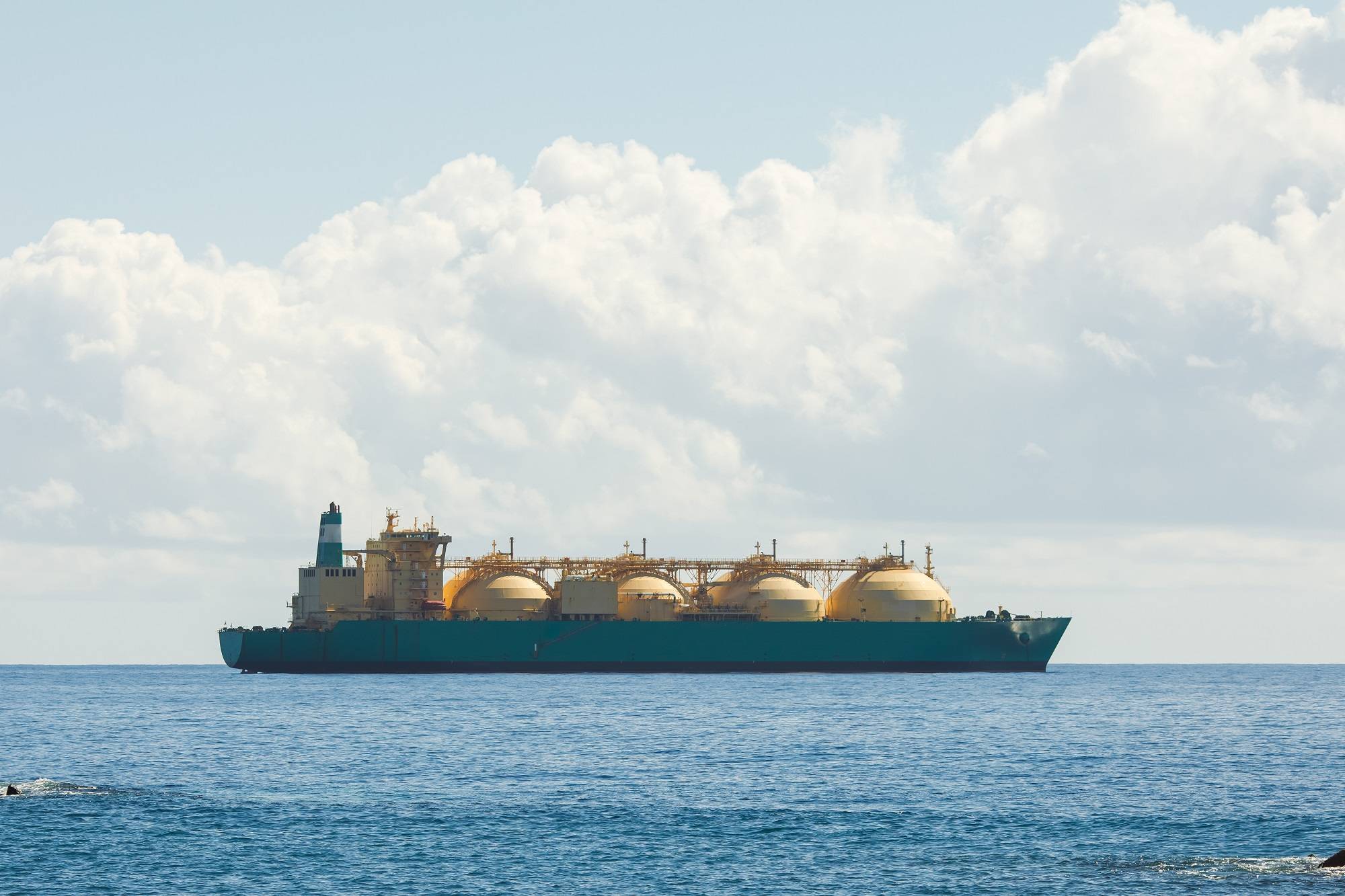
This new design, based on three identical high-capacity cargo tanks, aims to explore optimized operational costs (OPEX) without increasing capital expenditure (CAPEX) compared to conventional 174,000-cubic-meter four-tank LNG carriers.
It is reported that GTT’s new 200,000-cubic-meter LNG carrier concept received Approval in Principle from Lloyd’s Register and Bureau Veritas last year. This design breaks from tradition by replacing the conventional four-tank layout with a three-tank structure and adopting a reduced-speed strategy for more efficient and environmentally friendly operations. Compared to standard 174,000-cubic-meter LNG carrier designs, the three-tank configuration also reduces boil-off rates and shortens shipyard construction time.
This vessel type not only effectively reduces emissions but also provides a viable path toward more sustainable LNG shipping. The new design demonstrates significant environmental and economic benefits. Compared to traditional designs, emission intensity during operations can be reduced by approximately 27%. Under policy frameworks such as the EU Emissions Trading System (EU ETS) and FuelEU, the unit freight cost (UFC) could decrease by about 5.5% by 2025, with a potential reduction of around 14% by 2050.