But retailers face a dilemma. Cost-saving measures like route optimization and transportation management systems are now commonplace among retailers and their carrier partners. So, to cut last-mile costs further, chances are that they’re playing a zero-sum game by passing them along to consumers — and inadvertently hampering demand.
Hub to spoke to hub
Almost every part of the supply chain moves goods in bulk or batch orders. Typically, that bundling unravels once goods arrive at the last mile — but it doesn’t have to.
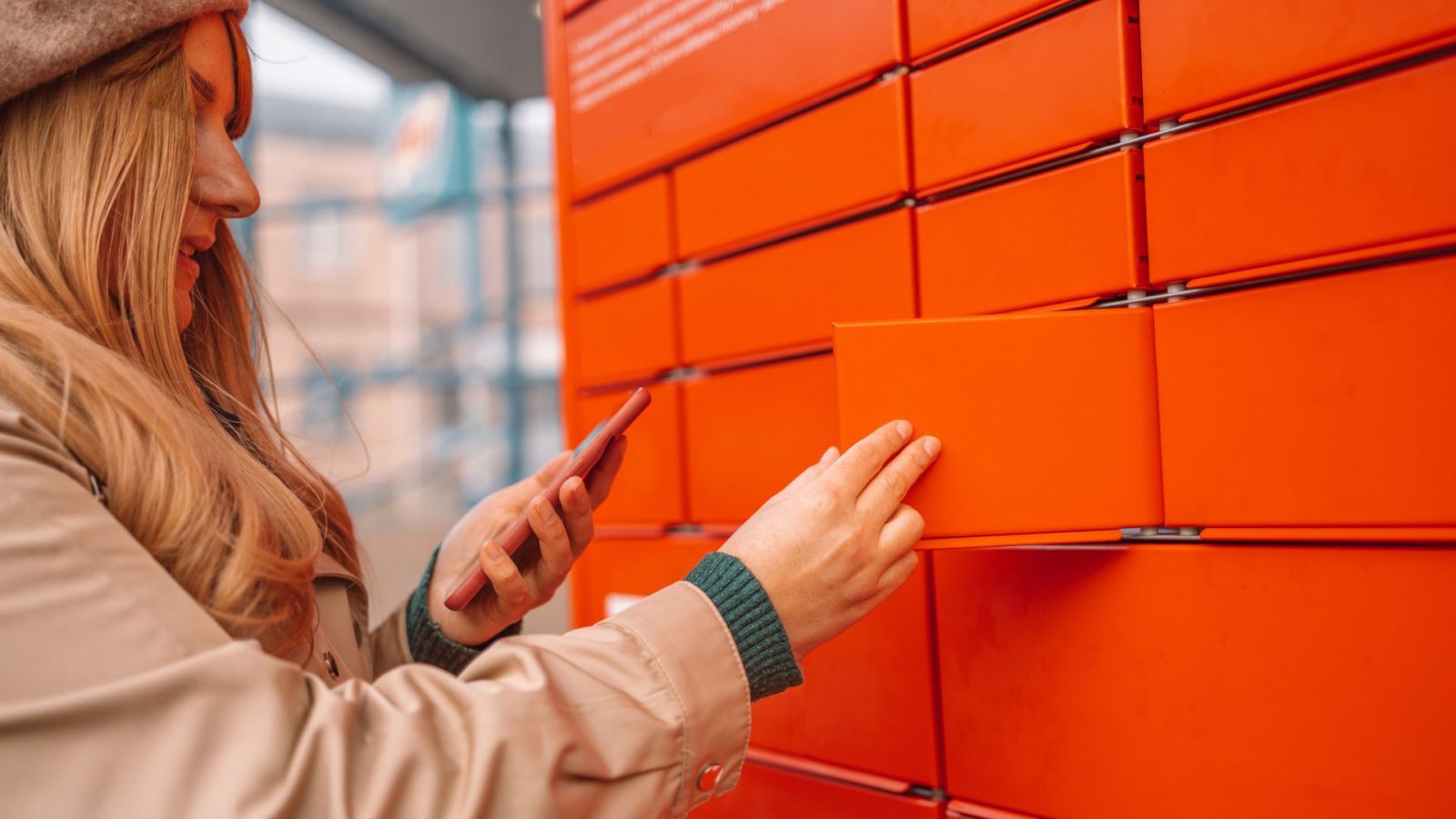
Using lockers, the two companies worked with supermarket chain Lowes Foods to help deliver groceries to hard-to-reach customers. At a central location in a senior living community, Delivery Solutions installed temperature-controlled lockers from Bell and Howell.
With a single dedicated drop-off zone, delivery vans were able to save the time and money it would take to deliver to each individual building. Meanwhile, customers were able to pick up orders at their convenience without having to worry about porch pirates.
The pilot with Bell and Howell, though, is just the precursor to a much larger vision. Mirza estimated that adoption of parcel lockers is low — less than 5% — but he envisions them being used widely by retail brands.
To paint a better picture, Mirza described parcel lockers as an extension of the common hub-and-spoke model: “Logistics companies have these spokes, and they would go from the warehouses — which were the hubs — to the spokes. And that point would be the launch pad for these last-mile providers to go to individual consumers,” he said. “But what they’re doing now is almost hub to spoke to hub, right? And that second hub becomes the lockers.”
Currently, hub-and-spoke is mainly used in the middle mile, where carriers distribute goods between central warehouses and fulfillment centers. But Mirza sees lockers becoming the hub of the last mile, with consumers themselves replacing delivery vans as the spokes.
Locker democracy
A few things need to happen before that becomes reality. First, lockers need to become consumer-agnostic, accessible to any consumer in the area. Mirza suggested that locker companies could use a reservation model, much like a restaurant.
“The end consumer can have temporary ownership of a locker and then have different retailers actually use their locker as a drop-off point,” he explained. “That brings in the complexity of multiple brands accessing the locker and the security that’s behind that.”
But it’s not enough for any consumer to have access. As Mirza alluded to, last-mile lockers will also need to be retailer- or carrier-agnostic, meaning that locker manufacturers don’t have exclusive arrangements with any one company. A few already do this, including Bell and Howell. Essentially, these lockers are democratized, with multiple retailers or carriers given access.
“There is a growing concept of saying that these lockers don’t have to be in the retailer’s premises,” Mirza observed. “They can be outside of that and be available for various retailers to leverage.”
Mirza believes parcel lockers will play out in a sort of hybrid model, in which retailers install lockers in neighborhoods for use by multiple carriers and customers. But at the same time, they would be available to multiple retailers. That means a consumer could place orders with three different brands and have them all delivered to the same locker during a reserved time slot.
But it’s not just the consumer who benefits. The vast majority of retailers have adopted same- and next-day delivery services, and centralized parcel lockers would make them more efficient by consolidating multiple trips into one. Meanwhile, outside stores, lockers can reduce the wait and idle times for delivery vehicles.
By cutting down on those last-mile costs, which are often baked into the prices of goods, retailers can make products cheaper and in turn generate demand.
The key challenges
As with any new last-mile solution, parcel lockers will face some roadblocks before they become widespread. Intuitively, security would seem to pose the biggest challenge. But according to Mirza, the opposite is true.
“I think security is actually one of the reasons why lockers are becoming very favorable,” he said. “And in fact, people are starting to prefer lockers to having items delivered to their doorstep.”
Mirza believes lockers provide consumers with more control. Barring the case of a high-value item that needs to be signed for, retailers don’t really have a way to confirm that the customer actually received their order after it was dropped at their doorstep.
Lockers, though, have a more clear chain of custody. When a delivery arrives, retailers can send the customer a unique QR code or PIN number that expires when their selected pickup window closes.
The real challenge, in Mirza’s mind, is scale. Installing lockers nationwide in suburbs is challenging enough, and commercializing space in cities is even tougher. To install them countrywide, there will need to be a massive push from locker manufacturers, Mirza said.
“If you look at Germany or you look at Australia, one of the things that has happened in those countries is there have been local companies that have just really invested in putting lockers all over the nation. And the idea there has been, build it, and they will come,” he explained.
Success in last mile delivery happens in the final 100 feet
Amazon is leading the way in the U.S., with a network of tens of thousands of lockers in over 900 cities and towns. But that still won’t cut it. For lockers to truly make a difference in the last mile, that network would need to be in the hundreds of thousands, Mirza said.
Another problem with scaling parcel lockers is that they provide diminishing returns as the area gets denser. In the suburbs, last-mile delivery vehicles often have to travel miles between deliveries. In a city, that distance might be reduced to a single street.
“The benefits that come from lockers, at least from a cost standpoint, are definitely much higher when you start to go out where there is a large area,” Mirza explained. “It’s spread out, coverage is short — for tier two, tier three cities, it’s a no brainer.”
“It’s early days here,” Mirza admitted, “but the trajectory is in the right direction.”
The conventional wisdom is that growth will be driven by the strength of buy-online, pickup-in-store services, which are already used by two out of three Americans. But according to Mirza, that model is ready for the next stage of evolution.
“This is like buy online, pick up anywhere, right?” he suggested. “I don’t have to go to the specific retailer where I bought my product. I want to dictate where I pick it up … and I want to make sure that all my products come to that particular location.”