After decades of preparation, this is not only a “high-speed route” for flood discharge and drainage, but also a “new waterway” for river-sea-river intermodal transport.
Shanghai is building a 69-kilometer super waterway.
Linking industrial zone transformation, rural revitalization, and ecological landscape upgrades, future thousand-ton freighters will pass through the city via a “world-class waterfront area.”
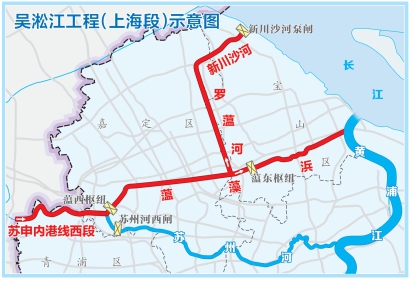
“Splitting into two routes” The Wusong River Project (Shanghai section) starts from the Shanghai-Jiangsu border, heading east along the Wenzaobang River. At the junction of Jiading and Baoshan districts, the river channel “splits into two routes”: one branch goes north, passing through the Luoyun River and Xinchuan Sha River, flowing into the Yangtze River; the other continues east, flowing into the lower reaches of the Huangpu River.
Have you noticed that the “heavy rain causing floods” that Shanghainese fear most is quietly being rewritten?
Many people still don’t know that Shanghai is carving out a super waterway with a total length of 69 kilometers and a width of about one hundred meters.
The investment in the Wusong River Project (Shanghai section) exceeds 55 billion yuan, a scale larger than the Suzhou Creek environmental comprehensive improvement project, which took 20 years and cost 40 billion yuan. Currently, the project has entered a critical phase: the Baoqian Highway Bridge is about to be raised and renovated; the main structure of the Xinchuan Sha River project is basically completed; preliminary work is advancing on the southern section of the Luoyun River. The entire project is expected to be fully completed by 2030.
Shanghai’s bold move to carve out a river hides a larger logic: Over the past 600-plus years, floodwaters from Taihu Lake passing through Shanghai have relied almost entirely on the Huangpu River, with the risk of waterlogging always looming, urgently requiring an additional safety line. However, this is only half the story. The true ambition of the Wusong River Project goes far beyond building a safety channel.
Making Space to Create Another Safety Channel
Why build the Wusong River Project? This is related to Shanghai’s geographical location.
Shanghai thrives on water but has long been troubled by it. Located in the lower reaches of the Taihu Lake basin, it has historically been the必经之地 (necessary passage) for Taihu floodwaters flowing eastward to the sea, with frequent flood disasters throughout history. Therefore, Shanghai’s development has always been intertwined with “flood control.”
Although flood control facilities are upgraded year by year, the hidden dangers have not been eradicated.
Some places are periodically troublesome. Jiading and Baoshan are naturally low-lying areas. Every flood season, residents live in anxiety. During the passage of Typhoon “Zhu Jie Cao” in 2025, several residential areas, road sections, and underpasses in Jiading experienced water accumulation.
Other places are increasingly “unaffordable to flood.” Data from the Shanghai Water Authority shows that even today, 80% of the water volume from the Taihu Lake basin ultimately converges into the main stream of the Huangpu River and discharges into the Yangtze River estuary. But the Huangpu River is not what it used to be; its banks are no longer factories and wasteland. Any stretch you pick is a hundred-billion-yuan industrial belt, unable to tolerate water levels exceeding the warning line for long periods.
The Wusong River Project is designed to eliminate these two major safety hazards.
A reporter learned from the Shanghai Municipal Major Project Office that the Wusong River Project (Shanghai section) starts from the Shanghai-Jiangsu border, mainly passes through Jiading and Baoshan districts, and heads east along the Wenzaobang River. At the junction of Jiading and Baoshan, the river channel “splits into two routes”: one goes north via the Luoyun River and Xinchuan Sha River into the Yangtze River; the other continues east into the lower reaches of the Huangpu River.
This route looks clear on paper, but building it is a mega-project. An industry insider revealed, “This project has been in the works for decades.”
Not because it wasn’t urgent enough, but because it is too “big.”
The first major challenge is coordination. The Wusong River Project is a major water conservancy project for the entire Taihu Lake basin, involving the two cities of Suzhou and Shanghai. Its essence is to build a drainage “high-speed route” for Taihu floodwaters directly to the Yangtze River, preventing the Huangpu River from bearing all the flood pressure.
Such a cross-provincial project is difficult to advance without unified coordination. From the project approval stage, coordination meetings between the two places have been continuous, with mechanisms innovated repeatedly. Led by the Municipal Major Project Office and the transportation departments of the two cities, the project department also established a Yangtze River Delta Integration Party Building Alliance with local authorities, leveraging the platform to open green channels for all construction links.
The G1503 expressway bridge, which needs to be demolished and rebuilt, is half in Jiangsu and half in Shanghai, with complex approval procedures. “The Municipal Major Project Office helped us coordinate, trying to bypass complex procedures without land acquisition or boundary expansion,” said Zhang Suya, then project manager and Deputy General Manager of the Safety Management Department of Tunnel Share Shanghai Road and Bridge.
The second major challenge is space constraints. Shanghai’s land resources are tight; it cannot simply dig a large river anywhere. It must be budget-conscious, squeezing space from existing land, repeatedly deliberating and adjusting plans concerning farmland, residential areas, industrial parks, and roads along the route.
Lan Peng, project manager of the Wusong River Project for Shanghai Chengtou, introduced that the team mainly utilizes existing river channels, widening and deepening them, while also excavating one new river channel.
Among these, only the Luoyun River is a completely new man-made river; the rest are renovations based on old river channels. Public information shows that the total land acquisition area involved in the project is approximately 10,000 mu.
Stacking Functions: Not Just for Flood Discharge, But Also for Cargo Transport
If used only for flood discharge, the spatial value would be too singular. Therefore, from the outset, it was also endowed with an important function — a Class III waterway. In the future, thousand-ton freighters will pass through the city via this route.
A Class III waterway is a high-grade inland river channel navigable for 1,000-ton vessels, requiring a minimum depth of over 3.2 meters and a riverbed width exceeding 45 meters. On the Xinchuan Sha River section in Jiading District, under the Qiancao Highway Bridge with the largest span, two dredgers are parked on the water, their grabs repeatedly scooping up riverbed silt to widen and deepen the channel. In just a few months, this section of the river has been widened from over 20 meters to 96 meters.
Some might ask: With railways and highways as dense as a spider’s web, is it necessary to build another inland waterway?
The recently released draft for comments of the “Shanghai Metropolitan Area Territorial Space Plan (2025-2035)” gives a clear answer: The waterway network, alongside the railway network and highway network, becomes one of the three pillars of the regional transportation system.
The reason behind this is very practical: Enterprises in the Yangtze River Delta all need cheaper logistics methods.
During a visit to the Yangtze River Delta, a reporter found that an inland river port located in a county town in Anhui Province achieved a cargo throughput exceeding ten million tons just three years after opening. Although the thousand-ton cargo ships on the Wusong River Project waterway can only carry about 20 containers at a time, water transport costs are very low. Referring to inland rivers like the Xiangjiang River, the cost is roughly half to a quarter of road transport, and also nearly half cheaper than railway transport.
“For bulk goods like building materials, coal, and ore, water transport is the most cost-effective. It can reduce pressure on road traffic and significantly lower enterprise costs,” Lan Peng said.
Furthermore, this waterway can achieve river-sea-river intermodal transport. Through water transshipment, the Wusong River can connect with Yangshan Port, which holds significant meaning for exports from Yangtze River Delta enterprises.
For example, Suzhou Industrial Park Port is an inland river port that can currently directly reach Shanghai Waigaoqiao, which mainly handles short-sea routes. If it can directly connect to Yangshan Port, which focuses on ocean routes, local enterprises’ goods could be shipped to European and American markets more efficiently.
This “economic calculation” goes beyond just logistics. Shanghai is also using this project to renovate the entire region.
Shanghai specially invited six top global design teams to conduct overall planning for the 170-square-kilometer area along the core section of the Wusong River Project. Currently, the “Wusong River-Wenzaobang River Waterway Project and Special Plan for Areas Along the Route” has been implemented. The planning content is not limited to docks, ports, and waterways but links industrial zone transformation, rural revitalization, and ecological landscape upgrades, attempting to activate the entire region with a single water vein.
Transforming Concepts: Water Conservancy Projects Become Urban Scenery
When you think of water conservancy hubs, do you picture gray concrete and high walls with deep courtyards? The Wusong River Project is different.
This is not just about digging a river; it’s about changing a construction philosophy for a city. In the past, urban projects prioritized functionality and being usable. Now, people increasingly pursue livability, so engineering projects naturally can no longer be gray facilities that fragment the city.
On the south side of Anzhi Bridge in Anting, Jiading, there is a place called Suzhou Creek West Sluice. From a distance, it looks like a modern small building next to a waterfront walkway. The sluice gate is hidden underwater, completely unobstructing the view. This gate usually lies on the riverbed, allowing ships to pass. When flood control is needed, it floats up, turns around, and blocks the floodwaters.
Lan Peng introduced that the “invisible” gate is actually a domestically pioneering fixed floating single-leaf gate. The gate is prefabricated in the factory and directly transported to the site for installation and prefabrication, compressing the construction time from the traditional one year to 115 days, making it both fast and aesthetically pleasing.
All 34 bridges along the Wusong River Project (Shanghai section) will also feature unique designs — single arch, double arch, steel truss, each with different forms. The overall prefabrication and assembly rate of the project exceeds 90%, significantly speeding up construction and reducing the impact on urban traffic.
Environmental aesthetics directly determine regional value. Looking back at the development and opening up of the Huangpu River banks, it is clear that a beautiful waterfront environment is a golden signboard for attracting high-tech industries and high-end talent.
Shanghai is benchmarking against the Huangpu River and Suzhou Creek, aiming to build the area along the Wusong River into a “world-class waterfront,” driving the development and transformation of surrounding areas and enhancing the vitality of the entire northern part of the city.
(Source: Liberation Daily, Reporter Qi Yingpu)