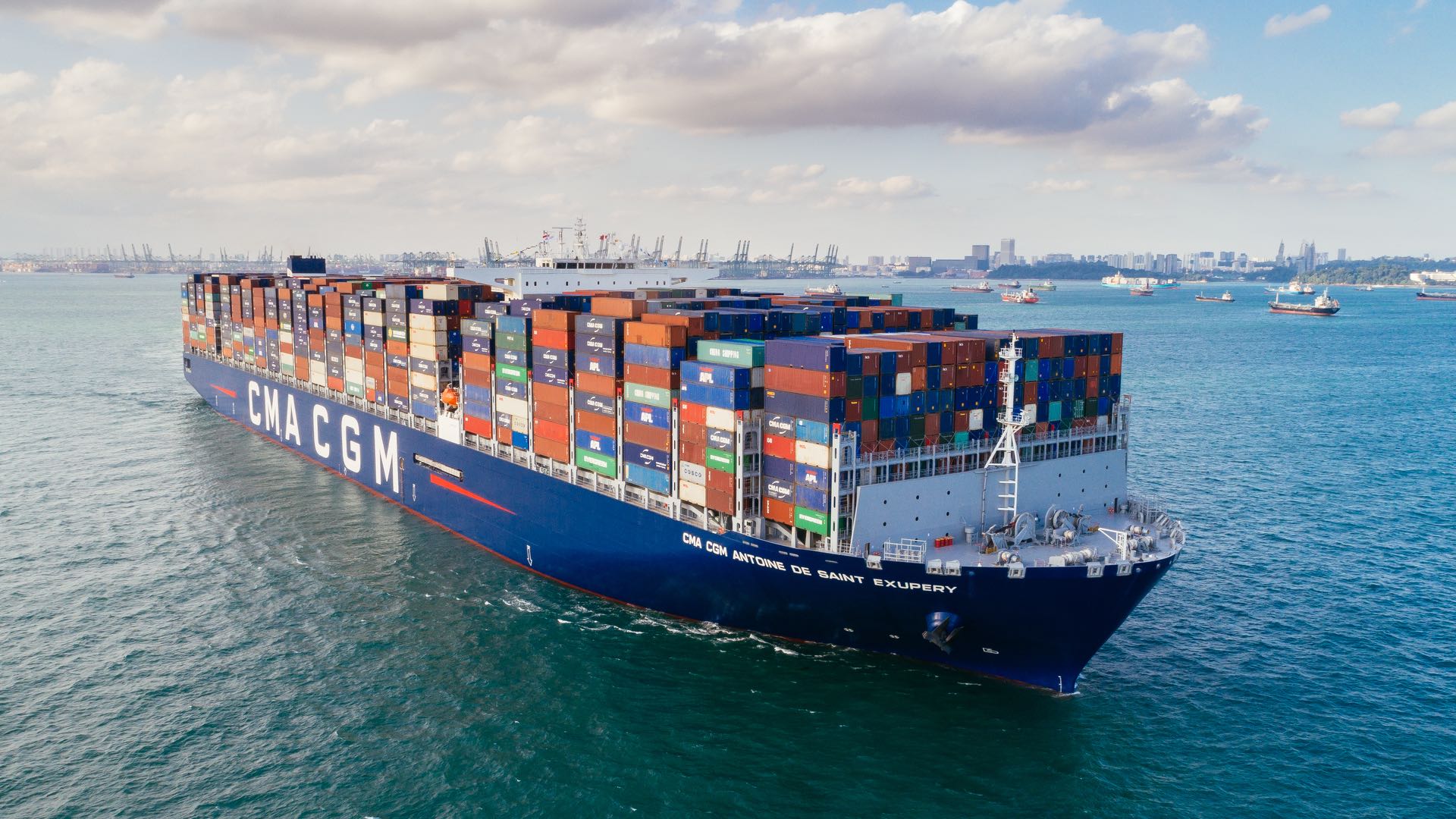
Cailian Press, October 30 (Reporter Hu Haoqiong) “The results of the new round of China-U.S. economic and trade consultations have brought positive changes, which are clearly beneficial for liner companies as they can reduce operating costs,” a relevant person from a domestic liner company operating U.S. routes revealed to a Cailian Press reporter.
Cailian Press reporters learned through multiple interviews that after the implementation of the new round of consultation results, traditional trade cargo volume is expected to increase, although the speed of response will vary among different customers.
“The results of the new round of China-U.S. economic and trade consultations have brought positive changes, and inquiries are expected to gradually increase,” a responsible person from Yunquna told a Cailian Press reporter, adding that customers previously more affected by additional tariffs are expected to recover faster, and some orders shipped from abroad may also shift back to China.
Gao Guangyu, co-founder of Lianyu Group, told a Cailian Press reporter that the new results will not have a significant impact on e-commerce cargo volume but will have a greater impact on traditional trade. Traditional trade cargo volume is expected to rise, mainly because traditional cargo mostly operates under FOB terms, and the previous high tariff costs suppressed buyers’ purchasing demand.
Furthermore, according to the customer notices issued by COSCO Shipping Lines, a subsidiary of COSCO SHIPPING Holdings (601919.SH), and Matson (MATX.US) before the implementation of port fee collection, these two listed liner companies are within the scope of the fees. Wu Jialu, chief researcher at CITIC Futures, told a Cailian Press reporter that based on the latest consultation results, the aforementioned vessels within the scope are expected to see a cost reduction of approximately $/TEU when subsequently calling at Chinese or U.S. ports.
Regarding short-term freight rate trends, Gao Guangyu stated that liner companies are expected to increase capacity subsequently, and the final market price will be linked to the matching degree of capacity, which is currently difficult to judge. The aforementioned liner company further stated that the company would maintain the current situation and would not adjust capacity on U.S. routes in the short term.
Wu Jialu told a Cailian Press reporter that recent VIZION data shows a rebound in booking volumes for Chinese goods shipped to the United States. Coupled with the impact of shipping company capacity adjustments and port fees, the SCFI freight rate for the US West route has also rebounded from low levels. The reduction in tariffs will further boost the motivation of Chinese enterprises to export goods to the U.S. market, which may be conducive to upward movement in shipping market freight rates.
It is noteworthy that before the announcement of the results of the new round of China-U.S. economic and trade consultations, tight space had already emerged on U.S. routes.
A freight forwarder for U.S. routes told Cailian Press that sailings for U.S. routes at the end of the month are very tight, and containers will be taken if not picked up promptly. This is mainly due to many shipping lines suspending services and reducing capacity, while the change in cargo volume is actually not significant. Data released by Drewry on October 27 shows that the main East-West shipping market is undergoing a new round of capacity adjustments. The eastbound trans-Pacific route has seen 40% of sailings canceled, making it the route with the second-highest number of cancellations.
Regarding European routes, Wu Jialu stated that it is currently entering the traditional peak shipping season for European routes in the fourth quarter. Coupled with shipping companies signing long-term freight rate agreements with customers for 2026, representative companies of the alliances have already pushed through two rounds of price increases since the second half of October, and it is expected there will be 1-2 more announced increases subsequently. Due to fewer European route vessels in week 46, congestion at European ports may further reduce available capacity in December, which may support shipping companies in continuing to realize announced price increases.
“The results of the new round of China-U.S. economic and trade consultations are favorable for the recovery of global trade cargo volume in the near term. In the short term, it is believed that EC will maintain a wide range of fluctuations, and the main strategy is to buy on dips. However, if the subsequent implementation of spot price increases falls short of expectations, the market may turn bearish overall. Attention should also be paid to marginal adjustments in market expectations for service resumptions and situations where price increases fall short of expectations,” Wu Jialu said.
Looking at the current spot freight rates for European and U.S. routes, data provided by Jiyu Technology shows that as of today, the lowest quotation from various liner companies for the U.S. route from Shanghai to the ports of Los Angeles and Long Beach is $/FEU, a decrease of $/FEU compared to the lowest quotation of $/FEU on October 27, but an increase of nearly 70% compared to the lowest quotation of $/FEU at the end of September. European routes, on the other hand, show a continuous upward trend. As of today, the lowest quotation for the Shanghai-Rotterdam route is $/FEU, an increase of $/FEU compared to the lowest quotation on October 27, and a 36.14% increase compared to the lowest quotation of $/FEU at the end of September.