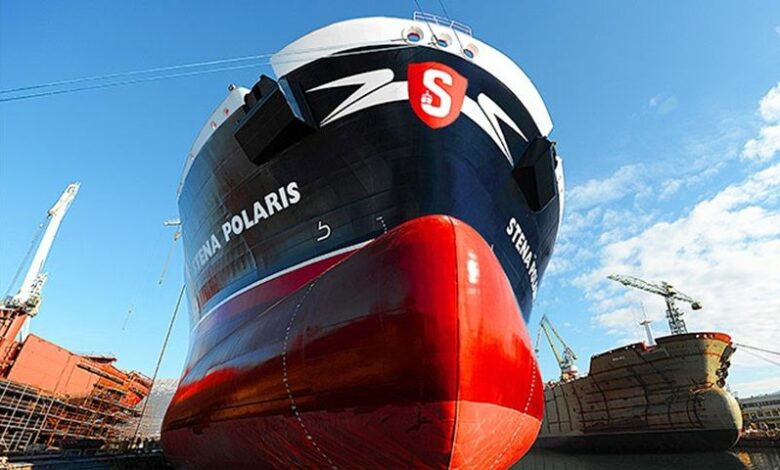
Developments regarding the Vertical Corridor are being charted by the commercial agreement of the ATLANTIC SEE LNG TRADE consortium for the supply and sale of Liquefied Natural Gas (LNG) from the USA as early as 2026, thus accelerating the implementation of this major project.
It is noted that on January 30, the consortium, in which the AKTOR Group participates with 60% and DEPA Trade with 40%, signed the first agreement for the sale of American LNG to Ukraine with BP as the supplier and the Ukrainian Naftogaz as the buyer.
The first LNG shipment to arrive at Revithousa will be sent to Ukraine in the coming March, that is in a few weeks, and the quantities to be delivered will be transshipped to Ukraine via Route 1.
Significant developments are expected in the near future, also in view of the crucial meeting scheduled at the White House on February 24, in which the Minister of Environment and Energy, Mr. Stavros Papastavrou, will participate.
This project plays a decisive role in the geopolitical upgrade of Greece and its emergence as a gateway for American LNG into Europe. And it constitutes a key element in the EU’s effort for energy security and complete independence from Russian gas.
It acquires particular importance after the Brussels decision for a definitive ban on Russian gas imports, which includes the provision with explicit reference to Turkstream, that any quantity of natural gas entering from Turkey into Greece and Bulgaria is considered prima facie of Russian origin. Consequently, the burden of proof that a shipment does not contain Russian gas is transferred to the importers and the Turkish authorities, and the EU gains a legal basis to block flows that are not certified as “clearly differentiated” from Russian gas.
Russia began channeling gas to the region via Turkey and not via Ukraine, resulting in the old pipelines that carried gas southwards now being almost empty. At the same time, since 2021, gas began flowing from Azerbaijan via the TAP pipeline (which passes through Northern Greece and ends in Italy), while in 2022 the Greece-Bulgaria Interconnector (IGB) was put into operation, and in 2024 the floating storage and regasification unit (FSRU) in Alexandroupoli also started.
With these projects, our country has acquired a system that can channel quantities northwards, resulting in us exporting natural gas to our neighbors since 2022. However, this system operates below capacity because there is still Russian gas in the region. According to the same sources, flows from Turkey – the main entry gate for Russian gas – have increased by 60% in recent years (from 2021 to 2025). Now, with the latest EU decision, which targets any quantity passing through Turkstream, Greece gains a strong advantage.
Speaking last week at the Athens Energy Summit, Mr. Papastavrou emphasized that “the vertical corridor is a multifaceted and demanding undertaking, without historical precedent, with unique strategic importance for stability in the region. There has never been a common product that enters Greece and reaches Ukraine.” And he explained that creating a unified and competitive product requires close cooperation: “Five countries, five management and regulatory authorities must cooperate. This by its nature is a very difficult undertaking.
“He wants discussion and the creation of a culture of cooperation.”
Sources from the Ministry of Environment and Energy (YPEN) underline that the “Vertical Corridor” will come of age when sanctions against Russian gas are implemented, which through gradual measures culminate in a complete ban by the end of 2027.
Commenting on the recent auctions concerning the Route 1, 2, 3 products (which concern supplying the vertical corridor originating from the Revithoussa, Alexandroupoli, and TAP LNG terminals respectively) and why they did not have the expected response, they explain that in Europe, gas transportation is priced with an entry-exit system. That is, to transport gas from Greece to Ukraine, a supplier must pay “tolls” in all intermediate systems. Thus, the cost for the final recipient rises significantly.
The “Route 1, 2, 3” products constitute an effort to create an “express ticket” that would go directly to Ukraine, securing a discount compared to the option of multiple “tolls.” It was created to help Ukraine cover its winter needs as much as possible, and to cover import needs that arose from attacks on Ukrainian infrastructure.
Finally, the “Vertical Corridor” is not only about gas. It also concerns other interconnections – road, railway, but also energy. In electricity, our country has now become a net exporter of electrical energy, supplying power to the wider region. But regarding natural gas, the “Vertical Corridor” is already operational, and will be fully utilized as imports of Russian gas are restricted with the imposition of sanctions the EU just decided on.