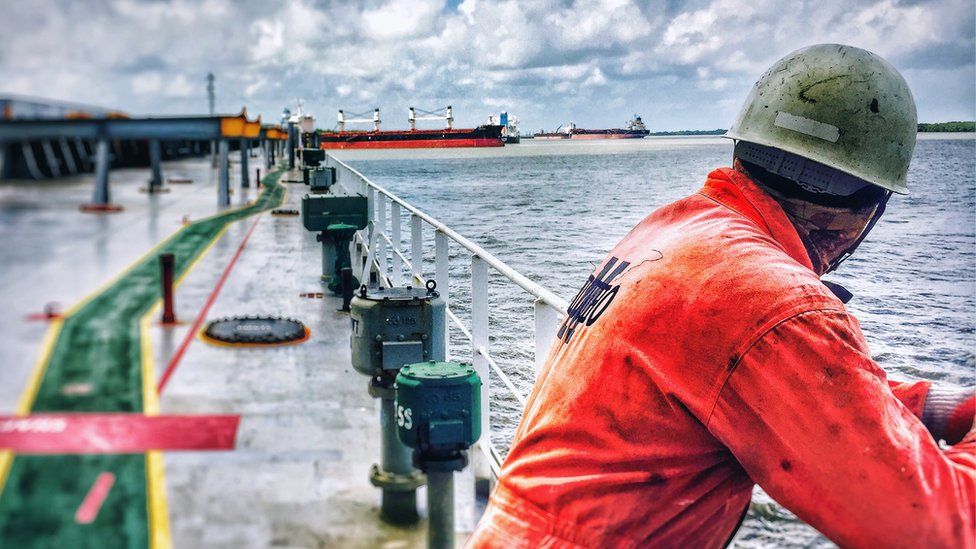
As Trump advances policies to revitalize the U.S. merchant fleet and boost the maritime industry during his second term, the demand for American mariners has become urgent. However, the reality is that the country faces a severe shortage of mariners, making it difficult to accomplish this challenging task.
In response to this situation, U.S. lawmakers have drafted a bill proposing subsidies for a new fleet of U.S.-flagged international trading vessels, whose officers and engineers must be American citizens.
According to The New York Times, international mariners can earn over $100,000 annually and enjoy up to six months of paid leave per year. It was this substantial compensation that initially attracted 29-year-old mariner Nicole Caputo to the seafaring profession. Since graduating from the SUNY Maritime College in 2018, Caputo has worked on 10 ships and currently serves as a second mate. She believes this income allows her to take good care of herself and her family.
Data from the U.S. Social Security Administration (SSA) shows the average annual salary in the United States for 2024 was $67,027.24.
Despite this, the number of new licensed mariners entering the industry is declining. The U.S. has only seven maritime academies—six state schools and the federal U.S. Merchant Marine Academy in Kings Point, New York. The federal academy is tuition-free, but state institutions require students to pay. According to data from the Maritime Administration under the U.S. Department of Transportation, the number of graduates obtaining Coast Guard licenses for shipboard roles has been consistently falling, dropping from 1,048 in 2017 to 810 last year.
Roland Rexha, Financial Secretary of the Marine Engineers’ Beneficial Association, stated that shipping companies have implemented several reforms to attract and retain mariners, such as improving meal quality and providing internet access at sea. However, he emphasized, “Increasing compensation is an issue that companies must address.”
It is reported that the fleet under the U.S. Navy’s Military Sealift Command, primarily responsible for supplying the Navy, is crewed entirely by civilians. Despite offering high salaries, the command still struggles to recruit mariners. According to its recruitment page, a chief mate’s annual salary exceeds $220,000, with an additional signing bonus of up to $71,000. Besides chief mates, the command is recruiting for 40 other positions, all requiring U.S. passports.
Due to the lack of civilian mariners, several ships in this fleet were forced to suspend routine operations last year.
Although the high salaries offered by U.S. merchant vessels are attractive, the nature of the work—requiring long periods at sea away from family—remains a significant challenge for mariners. One veteran mariner stated that in his 22-year career, he has only spent Christmas at home five times.
Currently, the seven U.S. maritime academies only graduate about 800 entry-level licensed mariners annually. However, shipping industry executives and academy officials reveal that some graduates choose to transition directly to shore-based jobs.
Graham Benton, Dean of Strategy and Academic Planning at the California State University Maritime Academy, said their graduates typically work at sea for about five and a half years before moving to shore-based roles. “It’s a lonely profession,” Benton admitted. “Many cadets are eager to return to land life and start families.”
Last month, at a mariner recruitment fair held by the Texas A&M University at Galveston maritime academy, one of the six state academies, numerous shipping companies were actively recruiting. Among them, Fairwater, which operates 42 tanker and chemical carrier vessels, has an annual recruitment target of 70 crew members. The company’s Senior Director, Jordan McDonald, believes Fairwater can meet its recruitment goals.
There is no official statistic on the number of available mariners for U.S.-flagged merchant vessels. Estimates from U.S. government and industry sources suggest there are now fewer than 10,000 active U.S. merchant mariners, a sharp decline from the approximately 50,000 in 1960. A 2017 report submitted to the U.S. House of Representatives noted that despite high employment rates for U.S. maritime academy graduates, “the number of credentialed, active mariners continues to decline.”
Veteran former merchant mariners analyze that the shrinking size of the U.S.-flagged fleet over recent decades is the primary reason for the mariner shortage—the fleet reduction forced large numbers of mariners to seek land-based jobs. Shipping executives reveal that many formerly U.S.-flagged shipping companies reflagged their vessels to other countries to reduce labor costs, allowing them to hire smaller crews at lower wages.
The key to increasing the U.S. mariner pool now lies in whether Trump and the U.S. Congress can achieve substantive results in their plan to revitalize the shipping industry. However, this plan has already encountered practical obstacles during its implementation.
Recently, the U.S.-China tariff war saw a significant development—both sides decided to suspend port fees for one year. The bill proposed by Congress plans to rely on revenue from these very fees to subsidize the new fleet of U.S. vessels crewed by U.S. mariners. Additionally, the bill plans to increase support for existing U.S. maritime academies and study the potential need for new ones.