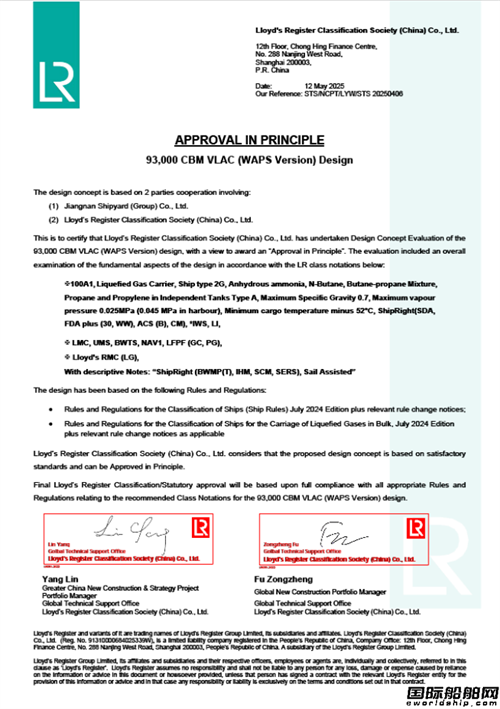
Recently, the application plan for rotor sail energy-saving technology on the 93,000 cubic meter ultra-large liquid ammonia carrier (VLAC), independently developed by China State Shipbuilding Corporation’s Jiangnan Shipyard, has officially received the Approval in Principle (AIP) certificate from the British classification society Lloyd’s Register (LR). This marks a new commercial milestone for the world’s first application of rotor sails on an ultra-large liquid ammonia carrier.
This achievement not only highlights Jiangnan Shipyard’s leading capabilities in ship energy efficiency optimization but also provides an innovative solution for the global shipping industry’s low-carbon transformation.
Wind-assisted propulsion systems are mainly divided into six categories: rigid sails, rotor sails, soft sails, suction sails, kite sails, and hull sails. Among these, rigid sails, suction sails, and rotor sails are relatively mature in terms of technological development, with rotor sails having the highest market share. Rotor sails operate based on the Magnus effect principle: when the rotating cylinder spins, the airflow on either side creates a pressure differential due to varying speeds, generating thrust perpendicular to the wind direction. This converts wind energy into propulsion for the ship, achieving energy-saving and emission-reduction effects.
Compared to other wind-assisted propulsion systems, rotor sails currently offer high technological maturity, a small wind-exposed area, strong stability, and excellent adaptability to wind direction, making them the most popular form of wind propulsion in the shipping industry today. They are primarily categorized into three types: fixed (simple structure, high safety), tiltable (suitable for strong wind environments and height-restricted scenarios), and rail-mounted (adjustable along tracks to improve sailing stability and port adaptability). With advancements in automation technology, rotor sails are rapidly evolving toward intelligent and modular designs.
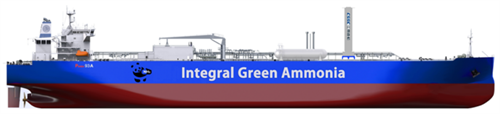
Facing increasingly stringent carbon emission regulations from the International Maritime Organization (IMO), Jiangnan Shipyard’s technical team collaborated with LR to conduct systematic research on various wind-assisted propulsion systems. They ultimately developed a tailored dual fixed-type rotor sail integration solution for the 93,000 cubic meter ultra-large liquid ammonia carrier. This solution meets the conventional air height requirements of ultra-large liquefied gas carriers while providing an alternative approach to addressing blind-spot visibility. The application of two fixed rotor sails is expected to reduce the ship’s main engine energy consumption by nearly 4%, with a single vessel cutting annual CO2 emissions by over 1,000 tons—delivering both economic and environmental benefits.
As a global leader in the liquefied gas carrier market, Jiangnan Shipyard remains committed to technological breakthroughs aligned with the “dual carbon” goals. The certification of the rotor sail project on the 93,000 cubic meter ultra-large liquid ammonia carrier not only validates the company’s green design capabilities but also marks a significant step in Jiangnan Shipyard’s decarbonization transformation. Currently, the shipyard is actively researching the application of rotor sail technology on more vessel types, such as LNGCs and VLECs, to develop standardized energy-saving solutions under the Jiangnan Shipyard brand.