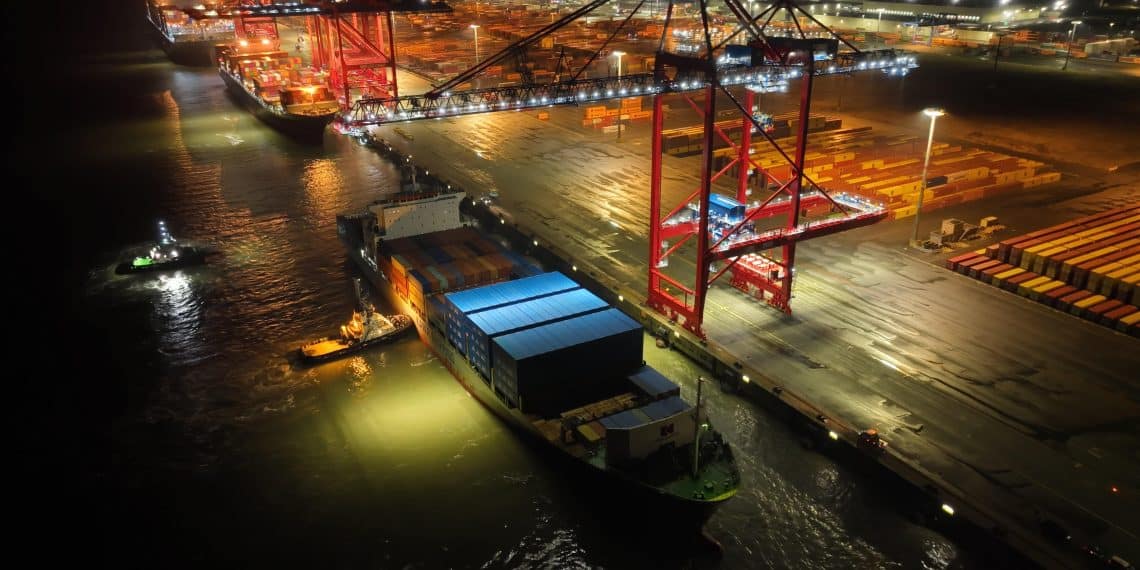
China News Service, Dongying, May 11 (Reporters Sha Jianlong, Chen Shizhao) On December 22, 2025, as the last container of the “Wanmuchun 32” vessel was smoothly unloaded, the annual cargo throughput of Dongying Port in Shandong Province exceeded 100 million tons for the first time, officially entering the ranks of “100-million-ton giant ports.” Today, on the southern coast of Bohai Bay, giant ships shuttle and crane booms rise and fall. On this former saline-alkali tidal flat, a modern deep-water port is accelerating its rise.
In recent years, the Dongying Port Economic Development Zone has anchored its development to the main line of port-industry-city integration, breaking through problems with systematic reforms. Major economic indicators have maintained double-digit growth, and its comprehensive strength ranks fourth among the “Top 30 National Chemical Industry Parks,” ranking first among competitive chemical parks during China’s “14th Five-Year Plan” period. Dongying Comprehensive Bonded Zone has continued to advance in national and provincial performance evaluations, achieving leapfrog development.
Port capacity achieves historic leap
Focusing on its positioning as a “national-level important port and national-level energy security port,” Dongying Port has invested a total of over 26.8 billion yuan, constructing 61 berths, including 34 open-to-foreign-vessels berths. Four 100,000-ton liquid berths, a 100,000-ton general-purpose berth, and a container terminal have been successively put into operation.
Particularly noteworthy is that the first 250,000-ton single-point mooring ultra-large crude oil terminal in northern China has been completed at Dongying Port. Within this year, direct voyages by very large crude carriers (VLCCs) will be realized, achieving a three-level leap in berthing capacity from “50,000 to 100,000 to 250,000 tons.” In the first quarter of this year, Dongying Port’s cargo throughput reached 23.18 million tons, a year-on-year increase of 7%, of which foreign trade throughput was 5.36 million tons, a year-on-year increase of 33%, significantly enhancing foreign trade support capabilities.
Sea-land linkage unblocks collection and distribution channels
The dedicated line for the first jetty of the Dongying Port port railway is under accelerated construction and is expected to be completed in June this year. It will then fill the gap in sea-rail intermodal transport, achieving multi-level linkage with Dongying City’s industries and the bonded industries of the comprehensive bonded zone. At the same time, Dongying Port is actively developing the “Shanxi-Shandong Logistics Corridor,” promoting the transshipment of “coal from west to east” and “coal from north to south” via Dongying Port for sea export. A 300-kilometer long-distance pipeline, a 60-kilometer public pipe gallery, and the longest port railway in China—a “sea-rail-road-pipeline” multimodal transport network is being rapidly woven.
Smart and green empowerment for high-quality development
Dongying Port has built China’s first “5G+” smart park and the first industrial internet demonstration platform in Shandong Province, increasing the automation rate of the entire chain to over 85%. It has introduced the deterministic network technology of Liu Yunjie’s team from the Chinese Academy of Engineering to enhance the modern governance level of the park.
In terms of green and low-carbon development, the Dongying Port area has taken the lead nationwide in formulating a green and low-carbon development plan for the park, with a carbon dioxide capture capacity of 250,000 tons per year, making it the only development zone in Shandong Province to pass the water-saving society acceptance. The park strengthens the dominant position of enterprises in innovation, possessing 36 provincial-level and above scientific research and innovation platforms, and has successively launched two batches of measures to optimize the business environment. Safety levels have also been simultaneously improved; the “Major Risk Prevention and Control Platform Project” has been officially launched, and the chemical skills training base has been completed and put into use. (End)