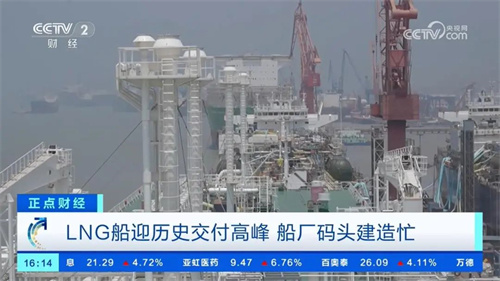
In recent years, the demand for liquefied natural gas (LNG) carriers has surged. As the delivery cycle for orders approaches, this year will see a peak in LNG carrier deliveries. What is the current status of LNG carrier construction at shipyards? Let’s take a look at the reporter’s findings.
On Changxing Island in Shanghai’s Chongming District, an LNG carrier slowly docked after more than ten days of sea trials. Shipyard officials told reporters that the 175,000-cubic-meter-capacity vessel had a highly successful trial. Final touches, such as painting and beautification, will now be completed at the port, with delivery expected within the year.
Qu Huanjun, Deputy Director of the Production Operations Department at Jiangnan Shipyard (Group) Co., Ltd.: “The sea trials went very well overall, with all indicators meeting standards. The performance has been highly praised by the shipowner and inspection parties. The third vessel is currently undergoing installation and debugging at the dock, with sea trials planned for mid-September.”
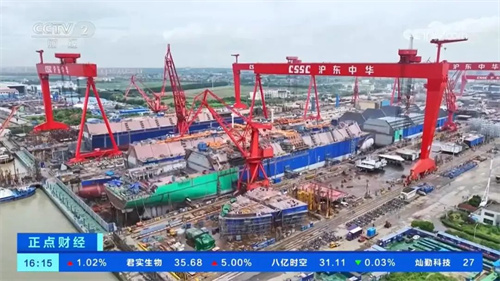
Reporters learned from multiple shipyards that as LNG carrier construction technology has matured in recent years, the average construction period has been reduced from 30 months to 15 months. A wave of LNG carrier orders is set to be delivered in 2025. At one shipyard on Changxing Island, workers were seen operating gantry cranes to assemble and weld hull sections, with teams working at full capacity. Meanwhile, multiple LNG carriers were under simultaneous construction in the docks. The shipyard stated that this year’s LNG carrier deliveries will hit a record high.
Weng Zhenyong, Deputy Director of the R&D Institute at Hudong-Zhonghua Shipbuilding (Group) Co., Ltd.: “This year, we expect to deliver over 10 LNG carriers. Currently, we hold around 60 LNG carrier orders, worth approximately 150 billion yuan, including 24 ultra-large LNG carriers with a capacity of 271,000 cubic meters. The production schedule is fully booked until 2031.”
As a key segment of high-end shipbuilding, LNG carriers have seen increasing localization in China, marking a significant milestone in the transformation and upgrading of the country’s shipbuilding industry. Marine engines, as the core component of ships, have drawn particular attention for their technological breakthroughs and localization progress.
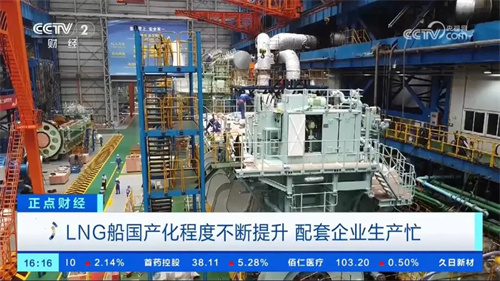
CCTV Reporter Wang Yannan: “I’m now at a marine engine manufacturing plant in Shanghai’s Lingang area. Behind me is a marine engine for an LNG carrier—measuring about 10 meters in length and width, and 13.5 meters in height, covering an area roughly the size of a standard badminton court. It uses dual-fuel technology, effectively reducing carbon emissions.”
In the assembly workshop of this large marine engine factory, reporters observed workers processing and assembling engine components before transporting them to test stations for final assembly. Technical director Xu Zhaogang noted that LNG carrier engines currently account for the highest proportion of deliveries, exceeding 50%.
Xu Zhaogang, Assistant General Manager and Head of the Technical Center at CSSC-MES Diesel Co., Ltd.: “Our production slots are fully booked, with 48 new engine orders added this year, showing growth compared to last year.”
It is understood that LNG dual-fuel engines have low carbon emissions and high added value, aligning with the green and eco-friendly trends in the shipping market. Marine engine manufacturers are accelerating technological innovation, achieving localization for components ranging from large engine cylinder liners to small crankshafts. The overall localization rate for engines has reached nearly 80%, while LNG carriers boast an overall localization rate of over 80%.
Liu Weidong, Technical Director at Jiangnan Shipyard (Group) Co., Ltd.: “Major materials such as steel, welding materials, and pipes have now achieved localization—from raw material procurement to prefabrication and processing—across the entire supply chain.”