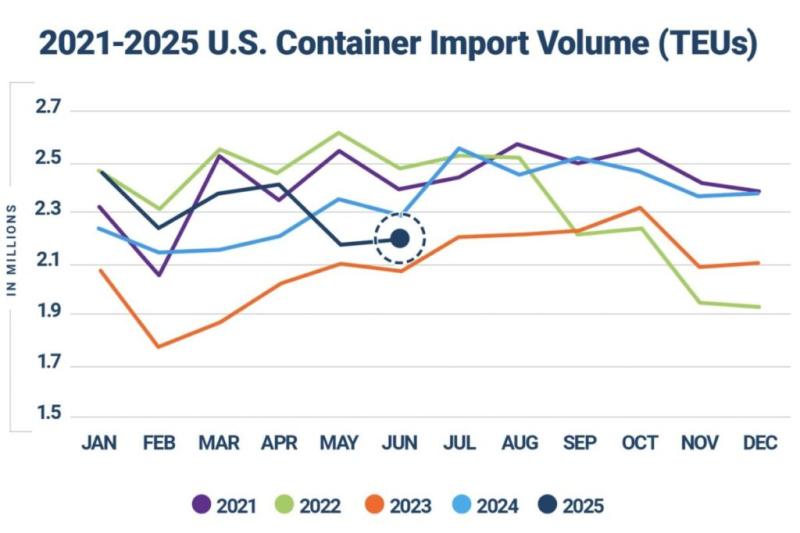
According to Descartes, US container import volumes in June 2025 reached 2,217,675 TEUs, marking a 1.8 percent increase over May’s steep 9.7 percent drop.
Building on this data, Descartes Systems Group has published its Global Shipping Report for July 2025, offering the latest analysis for logistics and supply chain professionals.
Compared to June 2024, volumes were down 3.5 percent, but remained 12.9 percent above pre-pandemic levels in June 2019, reflecting persistent structural demand despite ongoing trade challenges.
Importers are likely adjusting supply chains in response to global volatility; Descartes notes that for the first half of 2025, total imports were up 3.8 percent year-on-year, though growth has decelerated compared to earlier months.
China’s import volumes to the US were nearly flat in June 2025 at 639,300 TEUs, up just 0.4 percent from May, but have fallen 28.3 percent year-on-year. China’s share of total US container imports has also declined markedly, reaching 28.8 percent, the lowest in at least four years, and a considerable drop from the high of 41.5 percent recorded in February 2022.
This decline coincides with strong monthly growth from several Southeast Asian countries: Vietnam’s exports to the US rose 7.7 percent, Indonesia 17.3 percent, Thailand 8.6 percent, and Italy recorded a 9 percent increase.
Port dynamics also shifted in June, with West Coast US ports reclaiming market leadership over East and Gulf Coast ports by a 6.7 percent margin. Transit time delays improved notably, especially at the ports of Long Beach and Los Angeles.
Descartes’ Director of Industry Strategy, Jackson Wood, commented: “While US container imports posted a small rebound in June, the effects of US policy shifts with China in particular are visible for a second consecutive month.
“As US importers continue to assess and adapt their supply chains, two key trade deadlines – the July 9 expiration of the pause on sweeping Liberation Day tariffs and the August 10 expiration of the US–China trade truce – may create further pressure on businesses to bolster supply chain resilience in the wake of a quickly fluctuating trade environment.”